[Esp./Eng.] El latido universal de la Primavera. || The universal pulse of Spring.

If you prefer the English version, click on the following link 👉 HERE
Hay un momento exacto, casi imperceptible, en el que el mundo cambia de respiración. No es un día marcado con tinta roja en el calendario, sino un cambio en la densidad del aire. El hielo cruje —lo he escuchado— con una fragilidad que se siente y hay que vivirla, la tierra húmeda exhala un aroma a promesas subterráneas y la luz del sol, que durante meses pareció distante, opaca, y fría, vuelve a acariciar con intención. Es la llegada de la primavera.
Responder al llamado de la iniciativa de la comunidad de @talentos para darle forma a la palabra "primavera" es, en esencia, intentar atrapar la luz. Porque la primavera no es simplemente una de las cuatro estaciones meteorológicas; es la metáfora más antigua de la humanidad, un instinto biológico de supervivencia y un grito colectivo que celebra el triunfo de la vida sobre la tiranía del invierno.
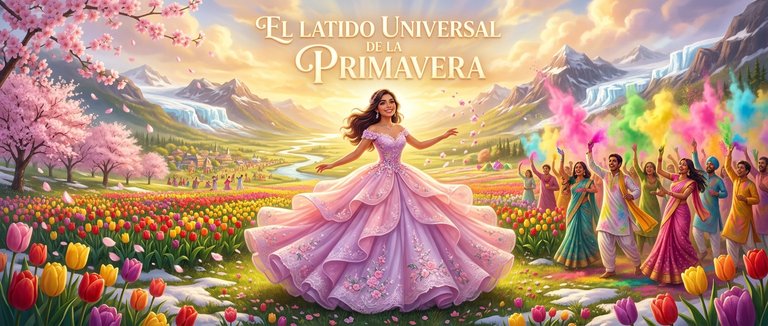
A lo largo y ancho del planeta, la humanidad no solo observa la primavera…, la actúa, la baila, la come y la viste. Acompáñenme en estos párrafos a través de los mapas y el tiempo, para descubrir cómo el mundo entero se pone de acuerdo en una única y colosal celebración universal pintada de colores y vivencias.
El eco de los dioses y los colores del mundo
Para entender la magnitud de la primavera, debemos mirar hacia el pasado. Históricamente, el invierno era sinónimo de oscuridad, escasez y miedo. Sobrevivir a la escarcha era una hazaña y vaya que lo era. Por eso, cuando los primeros brotes rompían la nieve, las culturas antiguas no veían un simple proceso botánico, sino un milagro divino.

En la antigua Grecia, ese reverdecer se explicaba con la mitología de Perséfone. Cada vez que ella regresaba del frío inframundo para abrazar a su madre, Deméter, la diosa de la agricultura, lloraba de alegría y la tierra entera florecía en respuesta. Esa misma idea de renacimiento espiritual permea el Nowruz, el Año Nuevo Persa, que se celebra exactamente en el equinoccio de primavera. En Medio Oriente y Asia Central, el Nowruz no es solo cambiar de calendario; es una limpieza profunda del hogar y del alma, un "nuevo día" donde el equilibrio perfecto entre la luz y la oscuridad —propio del equinoccio celta de Ostara— nos recuerda que después de la noche más larga, siempre regresa el amanecer.
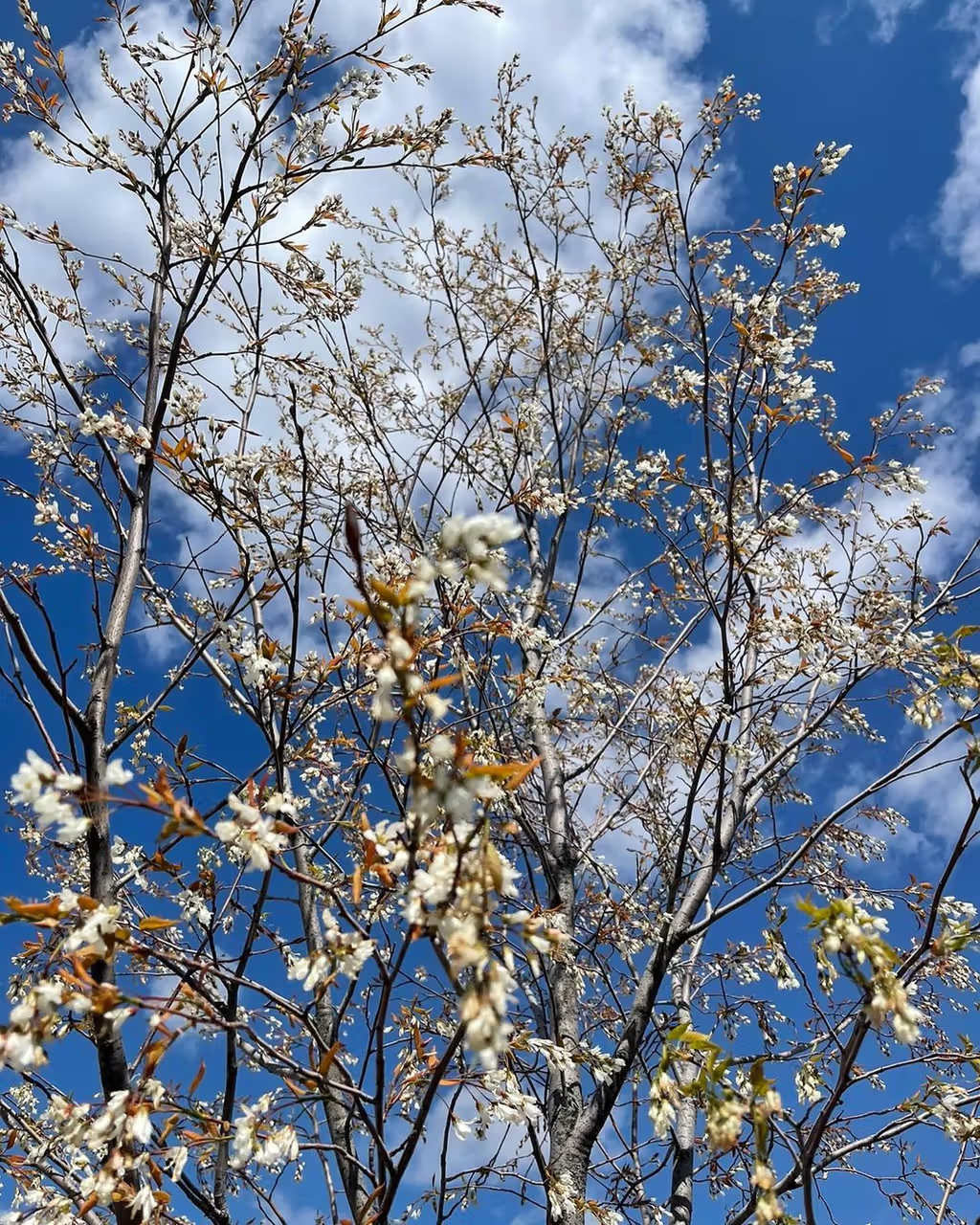
Pero si hablamos de darle forma a la primavera a través del color y la contemplación, debemos mirar hacia Asia. En Japón, la primavera se enmarca en la filosofía estética del Hanami, la observación de los cerezos en flor (sakura). Los japoneses se reúnen bajo nubes de pétalos rosados que duran apenas unos días antes de caer como nieve tibia. Allí, la primavera es más que alegría, es una lección sobre la belleza efímera de la existencia. Nos enseña que la vida es hermosa precisamente porque es fugaz. Y aun así, estamos empecinados a vivir eternamente.
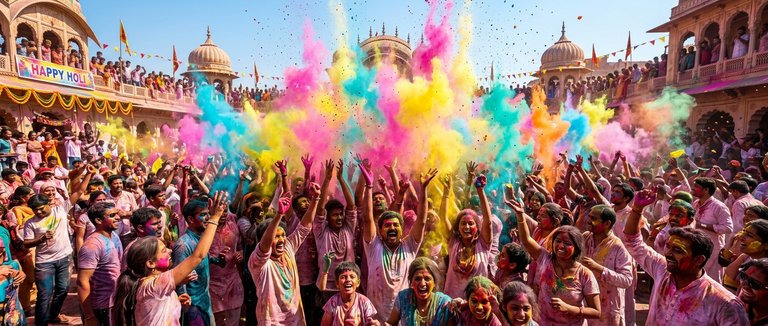
A miles de kilómetros de allí, en la India, la primavera carece de esa melancolía, su llegada estalla en un grito ensordecedor de alegría llamado Holi. Es el festival de los colores, donde millones de personas salen a las calles armadas con polvos brillantes (gulal) y agua teñida. Durante el Holi, el rojo de la fertilidad, el azul de Krishna y el amarillo de la cúrcuma borran temporalmente las estrictas castas sociales. Bajo el polvo de colores, todos son iguales. El Holi es la primavera entendida como el triunfo absoluto del bien sobre el mal, una risa colectiva que lava las penas del año anterior.
Ferias y rituales del deshielo
Ese instinto indio de salir a la calle en primavera se replica en cada rincón del planeta bajo distintas formas. La humanidad, tras meses de encierro invernal, experimenta una urgencia física de congregarse.
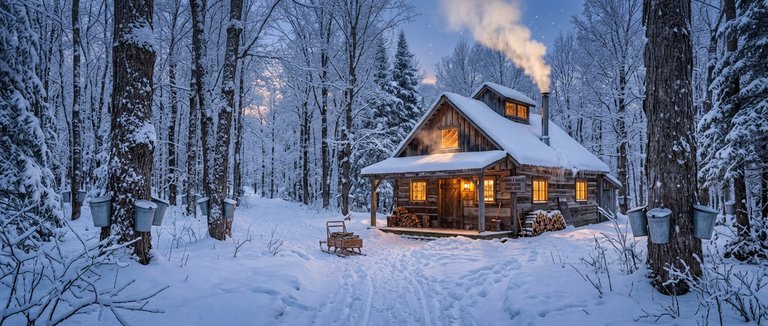
Pensemos en Canadá —tierra que me acogió—, un país que conoce muy bien el rigor del hielo. Aquí, la primavera huele a azúcar —aunque no lo crean—. Cuando la savia de los arces comienza a fluir, las familias se reúnen en las cabanes à sucre (cabañas de azúcar) para celebrar el fin de la escasez consumiendo el néctar dorado del jarabe de arce derramado sobre nieve que empieza a volverse líquida. Semanas después, Ottawa se convierte en un lienzo multicolor con el Festival de los Tulipanes, una fiesta cívica al aire libre. (El video les pondrá en contexto).
Este modelo de la "feria de primavera" es un fenómeno global. En Alemania —por ejemplo—, el letargo se rompe con el Frühlingsfest, una colosal fiesta de abril donde inmensas norias y carpas de cerveza reemplazan el paisaje nevado. En Suiza, la ciudad de Zúrich celebra el Sechseläuten llevando la confrontación con el invierno a un nivel literal: construyen un enorme muñeco de nieve lleno de explosivos llamado Böögg y le prenden fuego frente a miles de espectadores. Mientras más rápido estalle su cabeza, más hermoso será el verano —cada cultura sus locuras—.
Y, por supuesto, está la Feria de Abril en Sevilla, España —estoy plenamente seguro de que nuestra amiga @sacra97 complementará su visión de este evento en España—. Una ciudad efímera de lonas a rayas se levanta de la nada para albergar a mujeres vestidas de flamenca, guirnaldas de luces, caballos y vino fino. Aunque los códigos varíen desde el flamenco andaluz hasta las carrozas florales del Día del Estudiante en Argentina, el mensaje es unánime: la primavera exige que la celebremos juntos. Exige que el espacio público, antes inhóspito y helado, vuelva a ser nuestro hogar.
Las quince primaveras (El florecimiento interior)
Sin embargo, la primavera es tan poderosa que se niega a quedarse confinada en la botánica o en el calendario de festividades públicas. La humanidad ha interiorizado la primavera hasta convertirla en el reloj con el que medimos nuestra propia vida.
Existe una razón profunda por la que en Hispanoamérica no solemos decir que una joven cumple quince años, sino que "cumple 15 primaveras". Las estaciones del año son la metáfora perfecta de la vida humana. La infancia es el invierno: un estado de latencia, inocencia y protección bajo el cuidado de otros. La adultez es el verano ardiente, la época de trabajar la tierra y dar frutos. El otoño es la vejez y la cosecha de la sabiduría.
¿Qué es entonces la juventud?... Es la primavera. Es el momento de la transición, el despertar, la sangre alterada y el florecimiento.

Las Quince Primaveras de Arianis, hija de mi amigo Dr. Gaudris, en Caracas, Venezuela.
La tradicional fiesta de los 15 años —junto con los Sweet Sixteen anglosajones o el Baile de Debutantes europeo— es la encarnación ritual de la primavera humana, sin importar si la celebración ocurre en pleno mes de diciembre. En estos rituales de paso, que beben tanto de las ceremonias de pubertad de los pueblos mesoamericanos como de las presentaciones en sociedad de la aristocracia europea (que, por cierto, comenzaban su "temporada social" exactamente con el inicio de la primavera), la joven se convierte metafóricamente en una flor que se abre al mundo.
Todo en la estética de estos ritos grita "primavera". Los colores pastel (lilas, rosas, verdes agua) dominan la decoración. Los arreglos florales no son un mero adorno, son un símbolo del renacer. Y el vestido tradicional, con sus enormes capas de tul y faldas amplias, está diseñado, consciente o inconscientemente, para imitar la corola de una flor en su máximo esplendor, justo en el momento en que sus pétalos se abren. Celebrar los 15 años es celebrar la primavera de la vida, el adiós al capullo de la infancia y la bienvenida a la mujer que comienza a florecer.
Hacia una celebración universal
Al desglosar todas estas capas de significado, respondiendo al llamado de @talentos, nos damos cuenta de que no necesitamos inventar una celebración universal de la primavera; esa celebración ya existe, fragmentada en miles de tradiciones a lo largo de nuestro mundo.
Si pudiéramos unirlas todas en una sola plaza mística, veríamos una fiesta inabarcable. Estaría iluminada por la luz de los tulipanes canadienses y perfumada con el humo del invierno ardiendo en Suiza. La gente bailaría al ritmo del flamenco andaluz mientras el aire se tiñe de polvos de colores de la India y caen, como una lluvia suave, los pétalos de los cerezos japoneses. Y en el centro de todo, giraría una joven con su vestido pastel, marcando el paso de las generaciones y recordándonos que, pase lo que pase, el invierno nunca es eterno.
La primavera no es un momento en el año; es la testaruda insistencia del mundo en seguir viviendo. Es la juventud, es la luz, es la calle y es el color. Y darle forma con palabras en este espacio no es más que un intento humilde de sumarnos a esa danza inmemorial, para celebrar, una vez más, que hemos sobrevivido al frío.
Hace un tiempo publiqué en mi blog [Esp./Eng.] Equinoccio de primavera || Spring equinox que hoy quiero compartir con ustedes:
Cansado y agonizando,
días enteros de espera.
Ya llegó la primavera,
adiós los grises días del invierno.
El tic tac del reloj,
cada segundo cuenta.
Cada lágrima que brota,
El tiempo lo desdeña.
Las oscuras noches terminas,
hoy el día se iguala.
Son pares las horas
de día y de noche lágrimas.
No busques rima en mis versos,
son sentimientos al aire, brisa.
Por mis mejillas las gotas
al ritmo del tic tac, mis versos.
Adiós a la métrica,
un verso por sentimiento.
Ha llegado el equinoccio,
En él ahogaré mis penas.
¿Qué es la hoguera del tiempo?
al salir el sol se oculta la luna.
Ya estoy cansado de ver La Bruna,
Los minutos pasan en silencio.
Me cansé de contar pétalos,
ahora la rosa se marchita.
La primavera ha traído vida,
estéril han quedado mis ojos.
𝗘𝗻𝗰𝘂𝗲𝗻𝘁𝗿𝗼 𝗱𝗲 𝗧𝗮𝗹𝗲𝗻𝘁𝗼𝘀: «la primaver»

Portada de la convocatoria.
🔆****🔆****🔆****🔆****🔆****🔆****🔆****🔆****🔆
Dedicado a todos aquellos escribas que contribuyen, día a día, a hacer de nuestro planeta, un mundo mejor.


There is a precise, almost imperceptible moment when the world changes the way it breathes. It is not a day marked in red ink on the calendar, but rather a shift in the density of the air. The ice cracks—I have heard it—with a fragility that must be felt and experienced firsthand; the damp earth exhales the scent of subterranean promises; and the sunlight, which for months seemed distant, dull, and cold, returns to caress the earth with purpose. It is the arrival of spring.
Answering the call of the @talentos community initiative to give shape to the word "spring" is, in essence, an attempt to capture the light. For spring is not merely one of the four meteorological seasons; it is humanity’s oldest metaphor, a biological survival instinct, and a collective cry celebrating life’s triumph over the tyranny of winter.
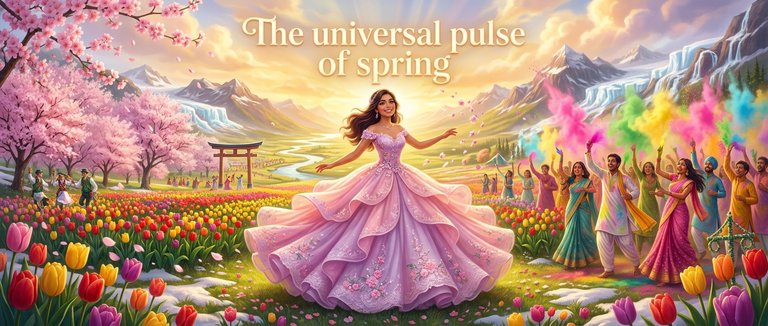
Across the globe, humanity does not merely observe spring... we enact it, dance it, eat it, and wear it. Join me in these paragraphs as we traverse maps and time to discover how the entire world unites in a single, colossal, universal celebration painted with colours and lived experiences.
The Echo of the Gods and the Colours of the World
To understand the magnitude of spring, we must look to the past. Historically, winter was synonymous with darkness, scarcity, and fear. Surviving the frost was a feat—and what a feat it was. That is why, when the first shoots broke through the snow, ancient cultures saw not merely a botanical process, but a divine miracle.
In ancient Greece, this renewal was explained through the myth of Persephone. Whenever she returned from the cold underworld to embrace her mother, Demeter—the goddess of agriculture—wept with joy, and the entire earth bloomed in response. That same concept of spiritual rebirth permeates Nowruz, the Persian New Year, celebrated precisely at the spring equinox. In the Middle East and Central Asia, Nowruz is not merely a change of calendar; it is a deep cleansing of both home and soul—a "new day" where the perfect balance between light and darkness (akin to the Celtic equinox of Ostara) reminds us that after the longest night, the dawn always returns.
Yet, if we speak of giving shape to spring through colour and contemplation, we must look to Asia. In Japan, spring is framed by the aesthetic philosophy of Hanami—the viewing of cherry blossoms (sakura). People gather beneath clouds of pink petals that last but a few days before falling like warm snow. There, spring is more than joy; it is a lesson on the ephemeral beauty of existence. It teaches us that life is beautiful precisely because it is fleeting. And yet, we remain intent on living forever.
Thousands of miles away, in India, spring is devoid of such melancholy; its arrival erupts in a resounding shout of joy known as Holi. It is the festival of colours, where millions take to the streets armed with bright powders (gulal) and colored water. During Holi, the red of fertility, the blue of Krishna, and the yellow of turmeric temporarily erase strict social caste distinctions. Beneath the colored dust, everyone is equal. Holi represents spring as the absolute triumph of good over evil—a collective laughter that washes away the sorrows of the year gone by. ### Thaw-time Fairs and Rituals
That innate urge to head outdoors in spring plays out in various forms across every corner of the globe. After months of winter confinement, humanity feels a physical need to gather together.
Consider Canada—my adopted home—a country intimately familiar with the harshness of ice. Here, spring smells like sugar—believe it or not. When maple sap begins to flow, families gather at cabanes à sucre (sugar shacks) to celebrate the end of scarcity by consuming the golden nectar of maple syrup poured over snow that is just beginning to melt. Weeks later, Ottawa transforms into a multicoloured canvas during the Tulip Festival, an open-air civic celebration. (The video will give you a sense of the scene.)
https://youtube.com/shorts/HQdCepyurgM?feature=share
This "spring fair" model is a global phenomenon. In Germany, for instance, the winter lethargy is broken by the Frühlingsfest, a massive April festival where towering Ferris wheels and beer tents replace the snowy landscape. In Switzerland, the city of Zurich celebrates Sechseläuten by taking the battle against winter quite literally: they build a giant, explosive-filled snowman known as the Böögg and set it ablaze before thousands of spectators. The faster its head explodes, the more beautiful the summer will be—every culture has its own brand of madness.
And, of course, there is the April Fair in Seville, Spain—I am quite certain our friend @sacra97 will add her own perspective on this Spanish event. An ephemeral city of striped canvas tents rises from nowhere to host women in flamenco dresses, strings of lights, horses, and fino wine. Though the traditions may vary—ranging from Andalusian flamenco to the floral floats of Student Day in Argentina—the message is unanimous: spring demands that we celebrate together. It demands that public spaces, previously inhospitable and frozen, become our home once more.
The Fifteen Springs (The Inner Bloom)
Yet spring is so powerful that it refuses to remain confined to botany or the calendar of public festivities. Humanity has internalised spring, transforming it into the clock by which we measure our own lives.
There is a profound reason why, in Spanish-speaking America, we do not simply say a young woman is turning fifteen, but rather that she is "turning 15 springs." The seasons of the year serve as the perfect metaphor for human life. Childhood is winter: a state of dormancy, innocence, and protection under the care of others. Adulthood is the scorching summer, a time for working the land and bearing fruit. Autumn is old age and the harvest of wisdom.
What, then, is youth?... It is spring. It is a time of transition, of awakening, of stirred blood and blossoming.

Paola's Quinceañera.
The traditional fifteenth-birthday celebration—much like the Anglo-Saxon "Sweet Sixteen" or the European debutante ball—is the ritual embodiment of human spring, regardless of whether the celebration takes place in the middle of December. In these rites of passage—which draw inspiration from both the puberty ceremonies of Mesoamerican peoples and the debutante balls of the European aristocracy (who, incidentally, began their "social season" precisely at the onset of spring)—the young woman metaphorically transforms into a flower opening up to the world.
Everything about the aesthetic of these rituals screams "spring." Pastel colours—lilacs, pinks, seafoam greens—dominate the décor. Floral arrangements are not merely decorative; they symbolise rebirth. And the traditional gown, with its voluminous layers of tulle and wide skirts, is designed—consciously or not—to mimic a flower’s corolla in full bloom, at the very moment its petals unfurl. Celebrating a fifteenth birthday means celebrating the spring of life: bidding farewell to the bud of childhood and welcoming the woman who is beginning to blossom.
Towards a universal celebration
As we unpack these layers of meaning—answering the call from @talentos—we realize that we do not need to invent a universal celebration of spring; that celebration already exists, scattered across thousands of traditions throughout our world.
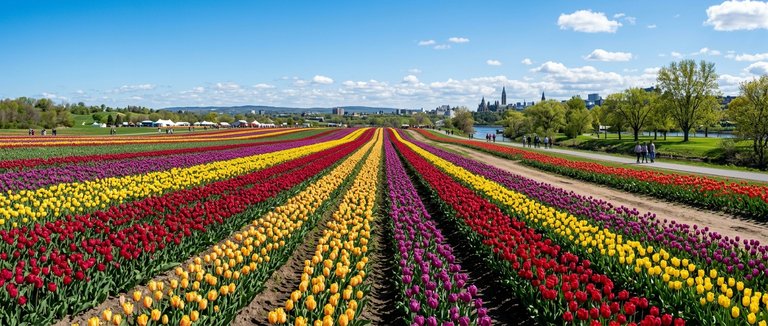
If we could gather them all in a single, mystical town square, we would witness a celebration of boundless scale. It would be illuminated by the glow of Canadian tulips and scented by the smoke of burning winter effigies from Switzerland. People would dance to the rhythm of Andalusian flamenco as the air filled with the colored powders of India and Japanese cherry blossom petals drifted down like a gentle rain. And at the centre of it all, a young woman in a pastel dress would twirl, marking the passage of generations and reminding us that, come what may, winter never lasts forever.
Spring is not merely a time of year; it is the world’s stubborn insistence on continuing to live. It is youth, it is light, it is the street, and it is colour. And giving it shape with words in this space is nothing more than a humble attempt to join that immemorial dance—to celebrate, once again, that we have survived the cold.
Some time ago, I published a post on my blog—[Esp./Eng.] Equinoccio de primavera || Spring equinox—that I would like to share with you today:
Weary and wasting away,
Through endless days of waiting.
At last, the spring is breaking,
Farewell to winter’s grey days.
The tick-tock of the clock,
Every fleeting second counts.
Yet every teardrop that spills,
Time cruelly discounts.
The darkest of nights are ending,
Today, the daylight aligns.
The hours are perfectly paired,
By day and by night, just tears.
Seek no rhyme within my verse,
They are feelings in the wind, a breeze.
Down my cheeks the teardrops fall,
To the rhythm of the tick-tock, my verse.
Farewell to the metre,
One line for every feeling.
The equinox has arrived,
Within it, I shall drown my sorrows.
What is this bonfire of time?
At sunrise, the moon hides from sight.
I am weary of gazing at the dark of night,
While the minutes pass by in silence.
I grew tired of counting petals,
Now the rose begins to wither.
Springtime has ushered in life,
Yet barren my eyes have remained.
Talent Encounter: ‘Spring.’...
Cover of the call for applications
🔆****🔆****🔆****🔆****🔆****🔆****🔆****🔆****🔆
Dedicated to all those writers who, day in, day out, help to make our planet a better place.
Portada de la convocatoria.
Dedicado a todos aquellos escribas que contribuyen, día a día, a hacer de nuestro planeta, un mundo mejor.
There is a precise, almost imperceptible moment when the world changes the way it breathes. It is not a day marked in red ink on the calendar, but rather a shift in the density of the air. The ice cracks—I have heard it—with a fragility that must be felt and experienced firsthand; the damp earth exhales the scent of subterranean promises; and the sunlight, which for months seemed distant, dull, and cold, returns to caress the earth with purpose. It is the arrival of spring.
Answering the call of the @talentos community initiative to give shape to the word "spring" is, in essence, an attempt to capture the light. For spring is not merely one of the four meteorological seasons; it is humanity’s oldest metaphor, a biological survival instinct, and a collective cry celebrating life’s triumph over the tyranny of winter.
Across the globe, humanity does not merely observe spring... we enact it, dance it, eat it, and wear it. Join me in these paragraphs as we traverse maps and time to discover how the entire world unites in a single, colossal, universal celebration painted with colours and lived experiences.
The Echo of the Gods and the Colours of the World
To understand the magnitude of spring, we must look to the past. Historically, winter was synonymous with darkness, scarcity, and fear. Surviving the frost was a feat—and what a feat it was. That is why, when the first shoots broke through the snow, ancient cultures saw not merely a botanical process, but a divine miracle.
In ancient Greece, this renewal was explained through the myth of Persephone. Whenever she returned from the cold underworld to embrace her mother, Demeter—the goddess of agriculture—wept with joy, and the entire earth bloomed in response. That same concept of spiritual rebirth permeates Nowruz, the Persian New Year, celebrated precisely at the spring equinox. In the Middle East and Central Asia, Nowruz is not merely a change of calendar; it is a deep cleansing of both home and soul—a "new day" where the perfect balance between light and darkness (akin to the Celtic equinox of Ostara) reminds us that after the longest night, the dawn always returns.
Yet, if we speak of giving shape to spring through colour and contemplation, we must look to Asia. In Japan, spring is framed by the aesthetic philosophy of Hanami—the viewing of cherry blossoms (sakura). People gather beneath clouds of pink petals that last but a few days before falling like warm snow. There, spring is more than joy; it is a lesson on the ephemeral beauty of existence. It teaches us that life is beautiful precisely because it is fleeting. And yet, we remain intent on living forever.
Thousands of miles away, in India, spring is devoid of such melancholy; its arrival erupts in a resounding shout of joy known as Holi. It is the festival of colours, where millions take to the streets armed with bright powders (gulal) and colored water. During Holi, the red of fertility, the blue of Krishna, and the yellow of turmeric temporarily erase strict social caste distinctions. Beneath the colored dust, everyone is equal. Holi represents spring as the absolute triumph of good over evil—a collective laughter that washes away the sorrows of the year gone by. ### Thaw-time Fairs and Rituals
That innate urge to head outdoors in spring plays out in various forms across every corner of the globe. After months of winter confinement, humanity feels a physical need to gather together.
Consider Canada—my adopted home—a country intimately familiar with the harshness of ice. Here, spring smells like sugar—believe it or not. When maple sap begins to flow, families gather at cabanes à sucre (sugar shacks) to celebrate the end of scarcity by consuming the golden nectar of maple syrup poured over snow that is just beginning to melt. Weeks later, Ottawa transforms into a multicoloured canvas during the Tulip Festival, an open-air civic celebration. (The video will give you a sense of the scene.)
This "spring fair" model is a global phenomenon. In Germany, for instance, the winter lethargy is broken by the Frühlingsfest, a massive April festival where towering Ferris wheels and beer tents replace the snowy landscape. In Switzerland, the city of Zurich celebrates Sechseläuten by taking the battle against winter quite literally: they build a giant, explosive-filled snowman known as the Böögg and set it ablaze before thousands of spectators. The faster its head explodes, the more beautiful the summer will be—every culture has its own brand of madness.
And, of course, there is the April Fair in Seville, Spain—I am quite certain our friend @sacra97 will add her own perspective on this Spanish event. An ephemeral city of striped canvas tents rises from nowhere to host women in flamenco dresses, strings of lights, horses, and fino wine. Though the traditions may vary—ranging from Andalusian flamenco to the floral floats of Student Day in Argentina—the message is unanimous: spring demands that we celebrate together. It demands that public spaces, previously inhospitable and frozen, become our home once more.
The Fifteen Springs (The Inner Bloom)
Yet spring is so powerful that it refuses to remain confined to botany or the calendar of public festivities. Humanity has internalised spring, transforming it into the clock by which we measure our own lives.
There is a profound reason why, in Spanish-speaking America, we do not simply say a young woman is turning fifteen, but rather that she is "turning 15 springs." The seasons of the year serve as the perfect metaphor for human life. Childhood is winter: a state of dormancy, innocence, and protection under the care of others. Adulthood is the scorching summer, a time for working the land and bearing fruit. Autumn is old age and the harvest of wisdom.
What, then, is youth?... It is spring. It is a time of transition, of awakening, of stirred blood and blossoming.
Paola's Quinceañera.
The traditional fifteenth-birthday celebration—much like the Anglo-Saxon "Sweet Sixteen" or the European debutante ball—is the ritual embodiment of human spring, regardless of whether the celebration takes place in the middle of December. In these rites of passage—which draw inspiration from both the puberty ceremonies of Mesoamerican peoples and the debutante balls of the European aristocracy (who, incidentally, began their "social season" precisely at the onset of spring)—the young woman metaphorically transforms into a flower opening up to the world.
Everything about the aesthetic of these rituals screams "spring." Pastel colours—lilacs, pinks, seafoam greens—dominate the décor. Floral arrangements are not merely decorative; they symbolise rebirth. And the traditional gown, with its voluminous layers of tulle and wide skirts, is designed—consciously or not—to mimic a flower’s corolla in full bloom, at the very moment its petals unfurl. Celebrating a fifteenth birthday means celebrating the spring of life: bidding farewell to the bud of childhood and welcoming the woman who is beginning to blossom.
Towards a universal celebration
As we unpack these layers of meaning—answering the call from @talentos—we realize that we do not need to invent a universal celebration of spring; that celebration already exists, scattered across thousands of traditions throughout our world.
If we could gather them all in a single, mystical town square, we would witness a celebration of boundless scale. It would be illuminated by the glow of Canadian tulips and scented by the smoke of burning winter effigies from Switzerland. People would dance to the rhythm of Andalusian flamenco as the air filled with the colored powders of India and Japanese cherry blossom petals drifted down like a gentle rain. And at the centre of it all, a young woman in a pastel dress would twirl, marking the passage of generations and reminding us that, come what may, winter never lasts forever.
Spring is not merely a time of year; it is the world’s stubborn insistence on continuing to live. It is youth, it is light, it is the street, and it is colour. And giving it shape with words in this space is nothing more than a humble attempt to join that immemorial dance—to celebrate, once again, that we have survived the cold.
Some time ago, I published a post on my blog—[Esp./Eng.] Equinoccio de primavera || Spring equinox—that I would like to share with you today:
Weary and wasting away,
Through endless days of waiting.
At last, the spring is breaking,
Farewell to winter’s grey days.
The tick-tock of the clock,
Every fleeting second counts.
Yet every teardrop that spills,
Time cruelly discounts.
The darkest of nights are ending,
Today, the daylight aligns.
The hours are perfectly paired,
By day and by night, just tears.
Seek no rhyme within my verse,
They are feelings in the wind, a breeze.
Down my cheeks the teardrops fall,
To the rhythm of the tick-tock, my verse.
Farewell to the metre,
One line for every feeling.
The equinox has arrived,
Within it, I shall drown my sorrows.
What is this bonfire of time?
At sunrise, the moon hides from sight.
I am weary of gazing at the dark of night,
While the minutes pass by in silence.
I grew tired of counting petals,
Now the rose begins to wither.
Springtime has ushered in life,
Yet barren my eyes have remained.
Talent Encounter: ‘Spring.’...
Cover of the call for applications
Dedicated to all those writers who, day in, day out, help to make our planet a better place.
Adoro la primavera 🦋, aunque al mismo tiempo sea mi nemesis 🤧, en fin, una más en la lista de las alérgicas a la primavera.
Por cierto, las flores de cerezo 🌸 son de mis favoritas, primavera, época de nacimiento y con gran significado ya que mi primer hija Rocío nació el día que nacía la primavera o como ella dice ahora "yo traje la primavera mami" 😊 😊