[Esp./Eng.] ¡Rómpete una pierna! || Break a leg!

If you prefer the English version, click on the following link 👉 HERE
Hoy es jueves, «𝐞𝐥 𝐜𝐮𝐞𝐫𝐩𝐨 𝐥𝐨 𝐬𝐚𝐛𝐞», 𝐞𝐥 𝐝𝐢́𝐚 𝐝𝐞𝐥 #TBT. Casi se me escapa el jueves sin cumplir con el ritual del #TBT, pero el corazón tiene su propia memoria y hoy me reclamó un espacio para volver a mirar estas fotografías.
Son tantas las fotografía que se tienen actualmente en físico o en digital. Todas llenas de historias...; tantas historias, que nos cuesta mucho decidir por cual publicar. Así que la foto que publicaré hoy será sacada al azar.
¡Rómpete una pierna!
El teatro tiene un olor particular, una mezcla de madera vieja, terciopelo pesado y el rastro eléctrico de los focos que calientan el aire. Me senté junto al Sr. Thomas, el padre de Flow, sintiendo esa inquietud familiar de quien espera un milagro cotidiano. En Venezuela decimos «sobrina putativa» para nombrar ese parentesco que no dicta la sangre, sino el afecto elegido. Y allí estaba ella, mi Flow, sentada en la tarima, con su sonrisa radiante desafiando la gravedad y la lógica.
Flow nació sin brazos..., para el mundo, eso es una carencia; para ella, es simplemente otra forma de ser. La vi acomodarse en la silla, con esa naturalidad que me sacó un par de lágrimas. Es que a ella, no le hacen falta brazos para abrazar la vida. Sus pies, expertos y delicados, se posicionaron sobre el metal dorado de la trompeta.
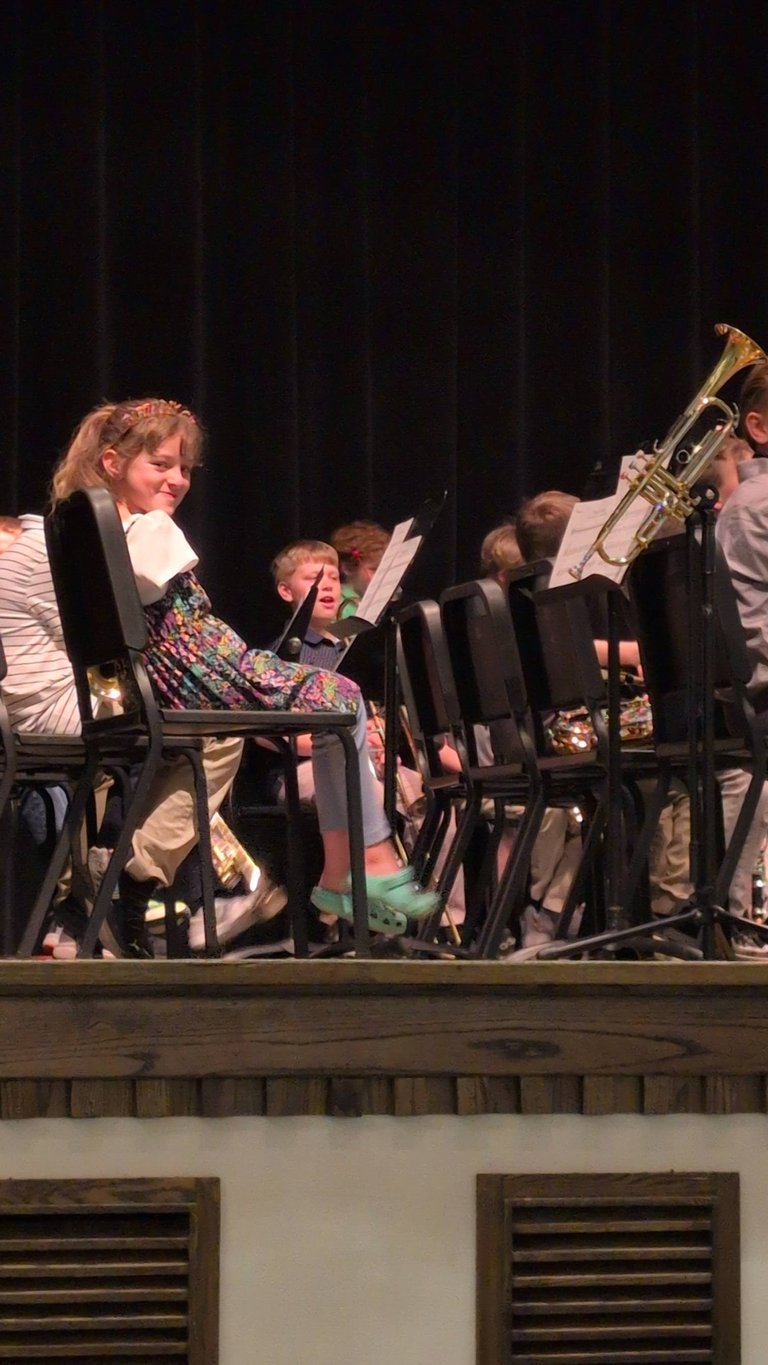
En ese silencio que precede a la primera nota, el Sr. Thomas se inclinó hacia adelante y, con una voz que retumbó en las paredes del auditorio, gritó:
—¡Break a leg, Flow! (¡Rómperte una pierna!).
Sentí un escalofrío. La frase me golpeó como un acorde disonante. Miré a Flow, que sostenía el instrumento con sus piernas, y luego miré a Thomas. Por un segundo, la literalidad de las palabras me pareció una cruel ironía, casi un error del destino. ¿Cómo desearle que se rompa una pierna a quien depende de ellas para crear belleza?
Thomas notó mi asombro. Me puso una mano en el hombro y sonrió explicándome los secretos de las palabras.
—Tranquilo —susurró, mientras el público empezaba a aplaudir—. En el teatro, la suerte es un animal esquivo y envidioso. Si le deseas a alguien «¡buena suerte!», los duendes del escenario se encargarán de arruinarlo todo por pura maldad. Así que los engañamos. Le deseamos lo peor, que se "rompa una pierna", para que el destino se confunda y le regale, por pura contradicción, una noche perfecta.

Entendí entonces que «Break a leg» no es un mal deseo, sino un escudo. Es el lenguaje secreto de los artistas para decir: «Eres tan grande que el destino va a querer boicotearte, pero yo te protejo con este conjuro al revés».
En ese momento, mientras Flow soplaba y sus dedos-pie danzaban sobre los pistones, el aire del teatro cambió. Sencillamente era música; era una frecuencia que yo conocía muy bien. Era el mismo "aire de vida" que tenía mi pequeña Sofía.
Sofía se fue a los once años, librando una batalla contra el destino que nos dejó a todos en silencio. Pero al ver a Flow, sentí que ese silencio se rompía. Había algo en el brillo de sus ojos, en la forma en que su alma parecía desbordar su cuerpo físico, que me hablaba directamente de mi hija. Era como si Sofía, a través de la trompeta de Flow, me estuviera enviando un mensaje codificado en notas musicales.
«Papá, sigo aquí, en la valentía de los que no se rinden», parecía decirme el eco de la melodía.
Flow no necesitó brazos para alcanzar el cielo... Me repetí varias veces. Y mientras Thomas y yo la veíamos brillar, comprendí que la verdadera suerte no es que no te pase nada malo, sino tener la fuerza para convertir cualquier "fractura" de la vida en una sinfonía.
Aquella noche, Flow no se rompió nada. Al contrario, me remendó un poco el alma, diría que a todos los que estábamos allí...
NOTAS IMPORTANTES A TENER EN CONSIDERACIÓN:
Para alguien que está aprendiendo el idioma o adaptándose a la cultura (en cualquier parte del mundo), escuchar que un padre le dice a su hija "rómpete una pierna" suena casi criminal, pero no lo es.
No se preocupen, ¡nadie terminó en el hospital! Estás ante una de las expresiones idiomáticas más famosas del mundo anglosajón: "Break a leg".
Les explico todo el trasfondo de esta curiosa frase:
1. ¿Qué significa realmente?
Significa, simple y llanamente, "¡Buena suerte!". Sin embargo, se usa casi exclusivamente en el mundo del espectáculo (teatro, danza, música) o en situaciones donde alguien debe presentarse ante un público (como una competencia).
2. ¿Por qué se dice algo tan "malo" para desear algo bueno?
La razón principal es la superstición. En el mundo del teatro (espectáculo) existe la creencia de que hay "duendes" o fuerzas del destino que son envidiosas. Si dices "¡buena suerte!", ellos lo escucharán y harán que algo salga mal. Por lo tanto, para "engañar" al destino, le deseas a la persona lo peor (que se rompa una pierna) para que, por el contrario, ocurra lo mejor.
3. Las teorías sobre su origen (son fascinantes):
No hay una sola versión oficial, pero estas son las más aceptadas y las que arrojaron mi investigación:
- La línea de las "piernas" (Vaudeville): En los antiguos teatros, las cortinas laterales que ocultaban a los actores antes de salir al escenario se llamaban "legs" (piernas). Para que a un actor le pagaran, tenía que salir a escena y "romper" la línea de esas cortinas. Así que "break a leg" significaba: "espero que logres salir al escenario y actuar para que te paguen".
- Hacer la reverencia: Antiguamente, cuando un actor tenía mucho éxito, el público aplaudía tanto que el actor debía hacer muchas reverencias doblando la rodilla (haciendo una flexión). Al "quebrar" la línea recta de la pierna para agradecer el éxito, se decía que estaba "rompiendo la pierna".
- En la antigua Grecia: En lugar de aplaudir, el público pisoteaba el suelo con fuerza. Se decía que, si la actuación era increíble, el público golpearía el suelo tan fuerte que alguien podría romperse una pierna.
4. La equivalencia en español (que también es rara)
Si esto *"Break a leg!" te parece extraño, recuerda que en el teatro en hispanohablante (especialmente en España) se utiliza la expresión: "¡Mucha mierda!", je, je, je...
- ¿El origen? Antiguamente, la gente rica iba al teatro en carruajes tirados por caballos. Si fuera del teatro había "mucha mierda" de caballo, significaba que el teatro estaba lleno y que la función era un éxito rotundo.
IMPORTANTE OBSERVACIÓN:
Puedes usar "Break a leg" con amigos antes de una presentación de trabajo, un examen oral o un concierto. Pero ¡👀!, no lo uses si alguien va a hacer algo realmente peligroso físicamente (como esquiar o hacer puenting), porque ahí podría malinterpretarse.
ℂ𝕠𝕟𝕔𝕦𝕣𝕤𝕠 𝕕𝕖 𝕋𝔹𝕋 - 𝕌𝕟 𝕕𝕚́𝕒 𝕕𝕖 𝕖𝕤𝕠𝕤.
También pueden revisar las últimas publicaciones en la casa de la Comunidad #TopFamily

Portada de la iniciativa.
A ver si se animan, las amigas @cirangela y @faniaviera, y el amigo @theshot2414…


Today is Thursday, “the body knows”, the day of #𝐓𝐁𝐓. I almost let Thursday slip by without observing the #TBT ritual, but the heart has its own memory and today it claimed a moment for me to look at these photographs again.
There are so many photographs we have nowadays, whether physical or digital. They’re all full of histories...; so many stories, in fact, that we find it very hard to decide which one to post. So the photo I’ll be posting today will be chosen at random.
Break a leg!
The theatre has a distinctive smell, a mixture of old wood, heavy velvet and the electric scent of the spotlights warming the air. I sat next to Mr Thomas, Flow’s father, feeling that familiar sense of anticipation one feels when waiting for an everyday miracle. In Venezuela we say ‘putative niece’ to describe that kinship dictated not by blood, but by chosen affection. And there she was, my Flow, sitting on the stage, her radiant smile defying gravity and logic.
Flow was born without arms... to the world, that is a deficiency; to her, it is simply another way of being. I watched her settle into the chair, with a naturalness that brought a couple of tears to my eyes. The thing is, she doesn’t need arms to embrace life. Her feet, skilled and delicate, positioned themselves on the golden metal of the trumpet.
In that silence preceding the first note, Mr Thomas leaned forward and, in a voice that echoed off the auditorium walls, shouted:
‘Break a leg, Flow!’
I felt a shiver. The phrase struck me like a dissonant chord. I looked at Flow, who was holding the instrument between her legs, and then I looked at Thomas. For a second, the literal meaning of the words struck me as a cruel irony, almost a twist of fate. How could you wish for someone who depends on their legs to create beauty to break a leg?
Thomas noticed my astonishment. He put a hand on my shoulder and smiled, explaining the secrets of the words to me.
“Don’t worry,” he whispered, as the audience began to applaud. “In the theatre, luck is an elusive and envious creature. If you wish someone ‘good luck’, the stage goblins will make sure to ruin everything out of sheer malice. So we trick them.” We wish them the worst, that they ‘break a leg’, so that fate gets confused and, out of sheer contradiction, gives them a perfect night.
I understood then that ‘Break a leg’ isn’t a bad wish, but a shield. It’s the artists’ secret language for saying: ‘You’re so great that fate is going to want to sabotage you, but I’ll protect you with this reverse spell’.
At that moment, as Flow blew and his toes danced over the pistons, the atmosphere in the theatre changed. It was simply music; it was a frequency I knew very well. It was the same ‘breath of life’ that my little Sofía had.
Sofía passed away at the age of eleven, fighting a battle against fate that left us all in silence. But watching Flow, I felt that silence breaking. There was something in the sparkle of his eyes, in the way his soul seemed to overflow his physical body, that spoke directly to me of my daughter. It was as if Sofia, through Flow’s trumpet, were sending me a message encoded in musical notes.
‘Dad, I’m still here, in the courage of those who don’t give up,’ the echo of the melody seemed to tell me.
Flow didn’t need arms to reach the sky... I told myself that over and over. And as Thomas and I watched her shine, I realised that true luck isn’t about nothing bad happening to you, but about having the strength to turn any ‘break’ in life into a symphony.
That night, Flow didn’t break a single bone. On the contrary, she mended my soul a little—I’d say she mended the souls of all of us who were there…
IMPORTANT POINTS TO BEAR IN MIND:
For someone who is learning the language or adapting to the culture (anywhere in the world), hearing a father say to his daughter ‘break a leg’ sounds almost criminal, but it isn’t.
Don’t worry, nobody ended up in hospital! You’re looking at one of the most famous idioms in the English-speaking world: “Break a leg”.
Let me explain the whole background to this curious phrase:
1. What does it actually mean?
It means, quite simply, ‘Good luck!’. However, it is used almost exclusively in the performing arts (theatre, dance, music) or in situations where someone has to perform in front of an audience (such as a competition).
2. Why do we say something so “bad” to wish for something good?
The main reason is superstition. In the world of theatre (the performing arts), there is a belief that there are “goblins” or forces of fate that are envious. If you say ‘good luck!’, they will hear you and make something go wrong. Therefore, to ‘trick’ fate, you wish the person the worst (that they break a leg) so that, conversely, the best will happen.
3. Theories about its origin (they’re fascinating):
There isn’t a single official version, but these are the most widely accepted ones and the ones my research turned up:
- The “legs” line (Vaudeville): In old theatres, the side curtains that hid the actors before they went on stage were called “legs”. For an actor to get paid, they had to go on stage and “break” the line of those curtains. So “break a leg” meant: “I hope you manage to go on stage and perform so that you get paid”.
- Taking a bow: In the old days, when an actor was very successful, the audience would clap so much that the actor had to take many bows by bending the knee (doing a squat). By ‘breaking’ the straight line of the leg to acknowledge the success, it was said that they were ‘breaking their leg’.
- In ancient Greece: Instead of clapping, the audience would stamp their feet hard on the ground. It was said that, if the performance was incredible, the audience would stamp the ground so hard that someone might break a leg.
4. The Spanish equivalent (which is also odd)
If this *‘Break a leg!’ sounds strange to you, remember that in Spanish-speaking theatres (especially in Spain) the expression used is: ‘lots of shit!’ ("Good luck"), heh, heh, heh...
- The origin? In the old days, rich people used to go to the theatre in horse-drawn carriages. If there was ‘lots of horse manure’ outside the theatre, it meant the theatre was full and the performance was a resounding success.
IMPORTANT NOTE:
You can use ‘Break a leg’ with friends before a work presentation, an oral exam or a concert. But 👀!, don’t use it if someone is about to do something physically dangerous (such as skiing or bungee jumping), as it could be misinterpreted in that context.
***
***
If you want to take part, I think you’re still in time – you’ve got until 11.59 pm TODAY, THURSDAY, so hurry up and remember to follow the rules.
With TBT contest - One of those days.
You can also check out the latest posts on the #TopFamily Community page
Cover of the initiative.
Let’s see if my friends @silher and @castri-ja, fancy joining in…
También pueden revisar las últimas publicaciones en la casa de la Comunidad #TopFamily
Portada de la iniciativa.
A ver si se animan, las amigas @cirangela y @faniaviera, y el amigo @theshot2414…
Today is Thursday, “the body knows”, the day of #𝐓𝐁𝐓. I almost let Thursday slip by without observing the #TBT ritual, but the heart has its own memory and today it claimed a moment for me to look at these photographs again.
There are so many photographs we have nowadays, whether physical or digital. They’re all full of histories...; so many stories, in fact, that we find it very hard to decide which one to post. So the photo I’ll be posting today will be chosen at random.
Break a leg!
The theatre has a distinctive smell, a mixture of old wood, heavy velvet and the electric scent of the spotlights warming the air. I sat next to Mr Thomas, Flow’s father, feeling that familiar sense of anticipation one feels when waiting for an everyday miracle. In Venezuela we say ‘putative niece’ to describe that kinship dictated not by blood, but by chosen affection. And there she was, my Flow, sitting on the stage, her radiant smile defying gravity and logic.
Flow was born without arms... to the world, that is a deficiency; to her, it is simply another way of being. I watched her settle into the chair, with a naturalness that brought a couple of tears to my eyes. The thing is, she doesn’t need arms to embrace life. Her feet, skilled and delicate, positioned themselves on the golden metal of the trumpet.
In that silence preceding the first note, Mr Thomas leaned forward and, in a voice that echoed off the auditorium walls, shouted:
‘Break a leg, Flow!’
I felt a shiver. The phrase struck me like a dissonant chord. I looked at Flow, who was holding the instrument between her legs, and then I looked at Thomas. For a second, the literal meaning of the words struck me as a cruel irony, almost a twist of fate. How could you wish for someone who depends on their legs to create beauty to break a leg?
Thomas noticed my astonishment. He put a hand on my shoulder and smiled, explaining the secrets of the words to me.
“Don’t worry,” he whispered, as the audience began to applaud. “In the theatre, luck is an elusive and envious creature. If you wish someone ‘good luck’, the stage goblins will make sure to ruin everything out of sheer malice. So we trick them.” We wish them the worst, that they ‘break a leg’, so that fate gets confused and, out of sheer contradiction, gives them a perfect night.
I understood then that ‘Break a leg’ isn’t a bad wish, but a shield. It’s the artists’ secret language for saying: ‘You’re so great that fate is going to want to sabotage you, but I’ll protect you with this reverse spell’.
At that moment, as Flow blew and his toes danced over the pistons, the atmosphere in the theatre changed. It was simply music; it was a frequency I knew very well. It was the same ‘breath of life’ that my little Sofía had.
Sofía passed away at the age of eleven, fighting a battle against fate that left us all in silence. But watching Flow, I felt that silence breaking. There was something in the sparkle of his eyes, in the way his soul seemed to overflow his physical body, that spoke directly to me of my daughter. It was as if Sofia, through Flow’s trumpet, were sending me a message encoded in musical notes.
‘Dad, I’m still here, in the courage of those who don’t give up,’ the echo of the melody seemed to tell me.
Flow didn’t need arms to reach the sky... I told myself that over and over. And as Thomas and I watched her shine, I realised that true luck isn’t about nothing bad happening to you, but about having the strength to turn any ‘break’ in life into a symphony.
That night, Flow didn’t break a single bone. On the contrary, she mended my soul a little—I’d say she mended the souls of all of us who were there…
IMPORTANT POINTS TO BEAR IN MIND:
For someone who is learning the language or adapting to the culture (anywhere in the world), hearing a father say to his daughter ‘break a leg’ sounds almost criminal, but it isn’t.
Don’t worry, nobody ended up in hospital! You’re looking at one of the most famous idioms in the English-speaking world: “Break a leg”.
Let me explain the whole background to this curious phrase:
1. What does it actually mean?
It means, quite simply, ‘Good luck!’. However, it is used almost exclusively in the performing arts (theatre, dance, music) or in situations where someone has to perform in front of an audience (such as a competition).
2. Why do we say something so “bad” to wish for something good?
The main reason is superstition. In the world of theatre (the performing arts), there is a belief that there are “goblins” or forces of fate that are envious. If you say ‘good luck!’, they will hear you and make something go wrong. Therefore, to ‘trick’ fate, you wish the person the worst (that they break a leg) so that, conversely, the best will happen.
3. Theories about its origin (they’re fascinating):
There isn’t a single official version, but these are the most widely accepted ones and the ones my research turned up:
- The “legs” line (Vaudeville): In old theatres, the side curtains that hid the actors before they went on stage were called “legs”. For an actor to get paid, they had to go on stage and “break” the line of those curtains. So “break a leg” meant: “I hope you manage to go on stage and perform so that you get paid”.
- Taking a bow: In the old days, when an actor was very successful, the audience would clap so much that the actor had to take many bows by bending the knee (doing a squat). By ‘breaking’ the straight line of the leg to acknowledge the success, it was said that they were ‘breaking their leg’.
- In ancient Greece: Instead of clapping, the audience would stamp their feet hard on the ground. It was said that, if the performance was incredible, the audience would stamp the ground so hard that someone might break a leg.
4. The Spanish equivalent (which is also odd)
If this *‘Break a leg!’ sounds strange to you, remember that in Spanish-speaking theatres (especially in Spain) the expression used is: ‘lots of shit!’ ("Good luck"), heh, heh, heh...
- The origin? In the old days, rich people used to go to the theatre in horse-drawn carriages. If there was ‘lots of horse manure’ outside the theatre, it meant the theatre was full and the performance was a resounding success.
IMPORTANT NOTE:
You can use ‘Break a leg’ with friends before a work presentation, an oral exam or a concert. But 👀!, don’t use it if someone is about to do something physically dangerous (such as skiing or bungee jumping), as it could be misinterpreted in that context.
If you want to take part, I think you’re still in time – you’ve got until 11.59 pm TODAY, THURSDAY, so hurry up and remember to follow the rules.
With TBT contest - One of those days.
You can also check out the latest posts on the #TopFamily Community page
Cover of the initiative.
Let’s see if my friends @silher and @castri-ja, fancy joining in…
You can also check out the latest posts on the #TopFamily Community page
Cover of the initiative.
Let’s see if my friends @silher and @castri-ja, fancy joining in…
Es un post muy bueno, tanto en la explicación de la frase, como en la historia de vida que compartes.
En una sola palabra: espectacular!!!
Gracias.
Sin duda maravilloso el mensaje que nos trajiste este jueves. Yo si lo había leído alguna vez es la frase correcta el deseo que se envía en el teatro, es como para que la mala suerte se aleje. Maravillosa entrada, menos mal que el cuerpo te lo recordó. Que niña tan fuerte y maravillosa. Un abrazo con fuerza.
!ALIVE
!BBH
!PIZZA
!LADY
!HUESO
View or trade
LOHtokens.@sacra97, you successfully shared 0.1000 LOH with @amigoponc and you earned 0.1000 LOH as tips. (4/30 calls)
Use !LADY command to share LOH! More details available in this post.
$PIZZA slices delivered:
@sacra97(6/15) tipped @amigoponc
Join us in Discord!