The Filipino Traditional Clothing Worn On Important Occasions: Barong Tagalog (piña/ jusi), Baro't Saya or Traje de Mestiza or Terno or María Clara, Modern T'nalak Dress and Malong | ASEAN Hive Community Challenge #157 🧣 Traditional Textiles

Filipinos are rich in culture, and we have colorful costumes that we are proud to wear on SPECIAL OCCASIONS to showcase our great heritage. Aside from that, we have different ethnic groups in the three islands of the Philippines, namely Luzon, Visayas, and Mindanao, that represent the different traditional textiles. In this article I only choose a few of them and here are my picks:

BARONG TAGALOG and BARO'T SAYA
The Barong Tagalog for men and the Baro’t Saya for women are the most popular clothing that worked by hand into Filipino identity. The Filipino textile fashion was influenced by the Spaniards who colonized the Philippines from 1565 to 1898. It has continuously evolved and withstood the test of time after the Spanish era. The Barong or Barong Tagalog dates back to the precolonial era in the Philippines.
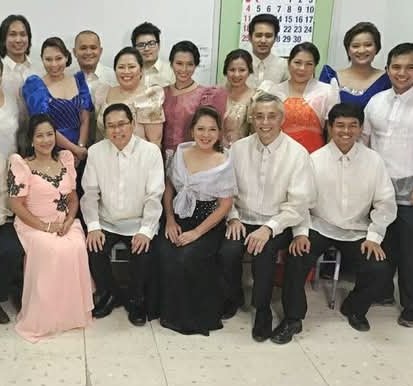
The "BARONG" has become the symbol of Filipino independence and resistance to colonization. Individuals and small groups of people had achieved socio-economic and cultural power in a way that they never had in the early days of colonization. Adherent to Catholic values, the "BARO'T SAYA" has been the symbol of the ideal Filipino woman, beautiful and conservative. The designs provided a way to distinguish the lower class from the aristocrats and had slight differences in the elements.
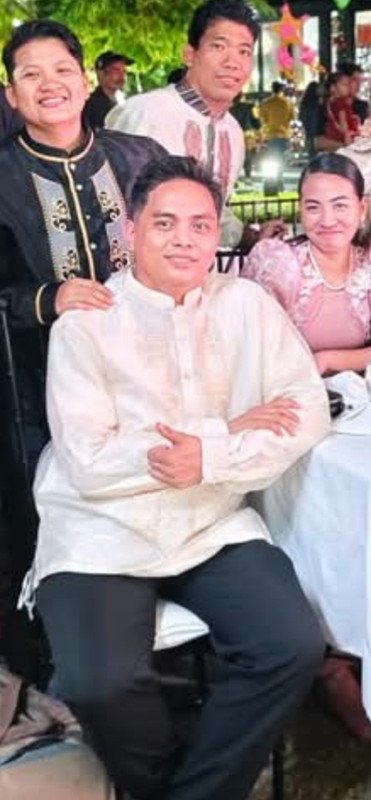
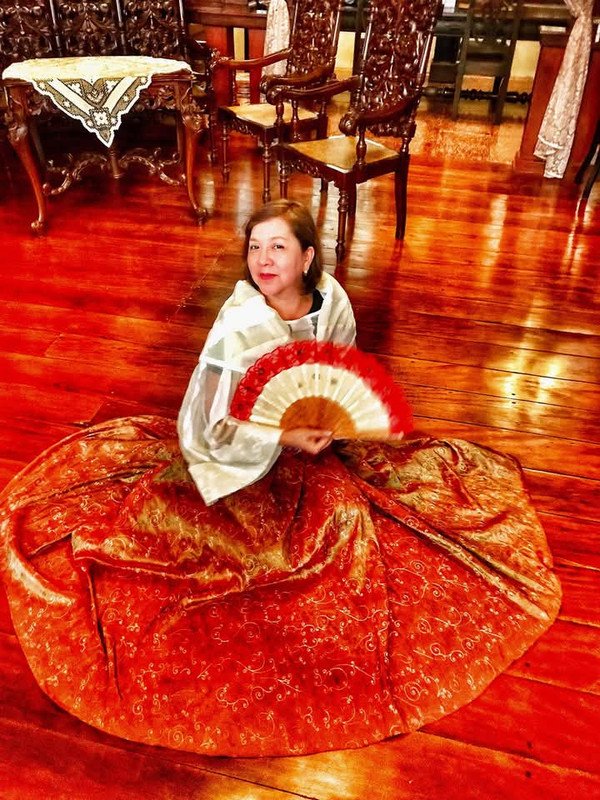
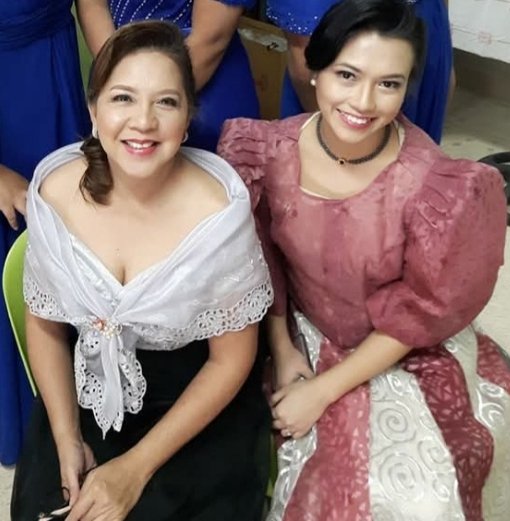
Nowadays, the BARO'T SAYA is worn during pageants and theatrical performances and is occasionally chosen as political or bridal attire.
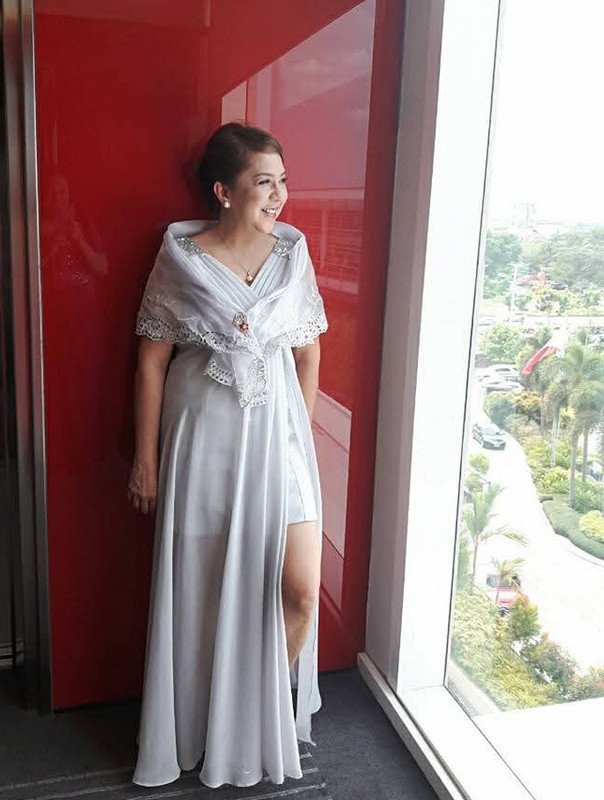
The "BARONG" is considered to be the formal clothing for men in the Philippines. The garment is usually worn on very important occasions like weddings and ceremonial events. Barong is made of "JUSI" material (banana silk) or "PINYA" fabric (pineapple leaf). It also showcases exquisite embroideries. Today, women also wear the BARONG TAGALOG with a skirt as the undergarment.

On the other hand, "BARO'T SAYA" is a loose ensemble composed of Baro, a fine fabric blouse fitted with butterfly sleeves, and a Saya, an elaborate skirt made of plaid or striped cotton. It is the everyday dress of every Filipino woman during the Spanish colonial period. Other names for this dress are Maria Clara, Traje de Mestiza, or Terno.
MODERN T'NALAK DRESS
The T'nalak pronounced as "TENALAK," fabric symbolizes the intricate and sacred patterns woven by the T'boli women. The enduring spirit and the journey from tradition to modernity, honoring the T'boli's legacy. T’nalak is a sacred cloth woven by the T'boli people in communities around Lake Sebu, Mindanao island. By memory and traditionally made by women of royal blood, thousands of patterns reference folklore stories. T’nalak has a distinctive tri-color scheme: white for the pattern, red for relief elements, and black (or deep brown) for the background. Prepared in a process known as kedungon fibers used in weaving are harvested from the abaca tree. Worked by hand into fine threads, two metal blades are used to quickly remove the pulp and reveal the filaments.
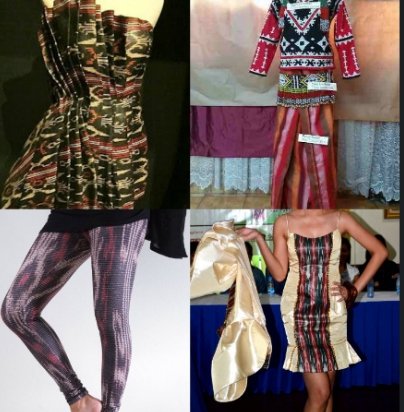
In T’boli's culture, the T'nalak fabric holds a special and prominent place. Birth, marriage, and death are ever present at significant turning points in T'bolis' life. It is the medium that sanctifies these rites, enveloping them in the length of its fabric like a benediction. In a culture that didn’t have a form of writing, the T’nalak served as both Literature and Art. The T’bolis expressed everything they are in the T’nalak: their dreams, beliefs, myths, and even their religion.
MALONG or TUBE FABRIC
One of the most well-known and commonly used fabrics, manufactured by Mindanao weavers is MALONG. It is a versatile tube fabric from Maguindanao and Maranao and has long been a mainstay of Philippine traditional apparel; it can be used as dresses, skirts, trousers, capes, hammocks, prayer mats, a "dressing room," and more. Other weaving groups in the Philippines weave their versions of the malong under other names.
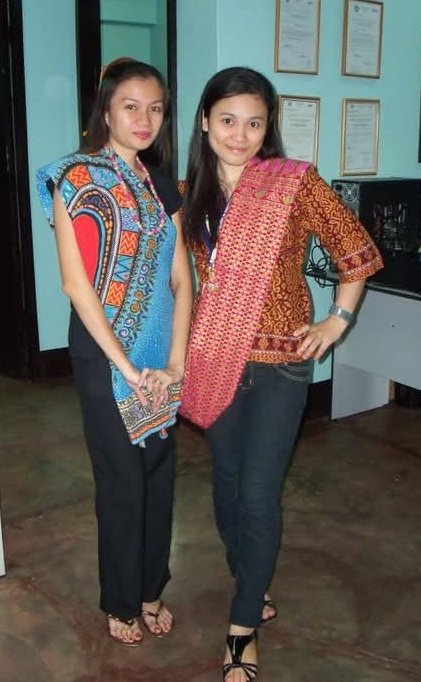
Malong is a traditional "tube skirt" created from handwoven or machine-made multi-colored cotton cloth with a variety of geometric or okir motifs. The Maranao Malong, called "LANDAP," has a design and style that could unveil the weaver's tribe origin.
Generally, both men and women alike wear it. They wrapped it over their entire bodies. The most popular way to style it is wearing the MALONG as a wrap-around skirt that reaches the wearer's feet. For ladies, this style of wearing the long is called Katinambed, and for men, Katampi. In addition, women usually drape one end of the long over their shoulders and wear it over their chest. We refer to this fashion as Kasinambir.

Thank you, #Hiveians, for fetching around my blog and checking out the post. Catch you on my next article.
1st photo edited by using Canva
All Glory and Honor to God

By adding #bilpcoin or #bpc to original posts, you can earn BPC tokens

https://peakd.com/hive-140084/@bpcvoter1/my-way-keni-bpc-ai-music
https://peakd.com/hive-126152/@bpcvoter2/dear-themarkymark-buildawhale-gogreenbuddy-usainvote-ipromote-and-whoever-else-is-involved-in-this-scheme-you-call-us-nutty-as
https://peakd.com/hive-167922/@bilpcoinbpc/exploring-the-possibilities-of-ai-art-with-bilpcoin-nfts-episode-102-buildawhale-scam-farm-on-hive-and-dear-steevc
https://peakd.com/hive-133987/@bilpcoinbpc/comprehensive-analysis-of-punkteam-s-wallet-transactions
https://hive.blog/hive-163521/@bpcvoter1/deep-dive-into-meritocracy-s-activity-history-and-blockchain-audit
https://www.publish0x.com/the-dark-side-of-hive/to-downvoters-scammers-and-farmers-on-hive-the-time-to-chang-xmjzrmp
https://peakd.com/hive-163521/@bpcvoter3/themarkymark-we-ve-exposed-your-actions-repeatedly-how-you-and-your-army-of-bots-manipulate-rewards-to-benefit-yourselves-it-s
https://peakd.com/hive-168088/@bpcvoter3/the-shadow-matrix-a-tale-of-deceit-and-reckoning
Decentralization isn’t just a feature—it’s a fight. Let’s model fairness, rally allies, and pressure Hive to live up to its ideals.
https://peakd.com/hive-167922/@bpcvoter3/5m1kft-themarkymark-you-can-keep-pretending-to-be-oblivious-but-the-truth-is-out-you-ve-been-exposed-it-s-time-to-own-up-to-your
#StandForDecentralization #HiveTransparency
Our traditional Filipino clothing is such a meaningful expression of our heritage. I still remember wearing my Filipiniana back when I was in government service, especially during regional award ceremonies. Wearing it made me feel proud.❤️
That's true. Most of my photos when I was working in a Regional Centers inside UPLB are taken our company's official photographer. Celfone in my time isn't a fad yet. I don't have a copy of those special occasions that were held in the company where I wore Filipiniana dresses. This one I posted was given to me by an officemate who happened to have a camera at that time. I love wearing Filipiniana dresses and true enough, wearing it makes me feel proud.
I don't know about you, but I love the traditional clothes. Although our weather here in the Philippines is usually humid and hot, I would like us to return to the old days when we wore such beautiful and not revealing clothes.
Your daughter looks pretty like you, Ate.
I do love our traditional clothes, especially the Traje de Mestiza or María Clara. When I was in grade school, I wore the Maria Clara traditional dress when I had my declamation "Ang Inang Bayan" I can vividly recall when my adviser, fixed my hair to let the dress stand out and I told her impishly that it's not the dress that carried the wearer but it's me who carried the dress.🤣🤣🤣 She pinches me on my groin because I outsmarted her..hahaha. She said: you little brat!🤩🤩🤩 I asked her: Am I right, teacher? Then she couldn't hide her smile.🥰
One of my fondest memories of Traje de Mestiza is when I wore it during the University of the Philippines Los Baños Loyalty Day. The Regionals Center has scholars from all over the Philippines and Southeast Asia and I was requested by them to be their Filipino counterpart to wear the traditional textile. I had fun and was proud of our traditional dress. We were the crowd's favorite because of the colorful traditional clothing that we wore. Malaysia, Indonesia, Brunei, Australia, Thailand, Singapore, and the like. Indeed, our traditional dress is a showcase of our great heritage.
Wearing it feels regal now for occasions and big events nalang. As for me, I haven't tried a traditional dress after school and it was elementary days already.
Great job of sending entry. Nakahabol parin.
Oh yes! I made it ahead of time!🤩🤩🤩 I thought I could not make it.🤗
As for me, no one can beat our traditional dress. It's so rich in colors, and each color has its meaning, too.
I used to wear Filipiniana dress before, when i was at my old job. Traditional clothes makes us filipinos unique. But, i like the modern filipiniana now. Very nice photos of yours.
It's delightful to know that you wore it in your workplace. Did you work at Department Of Tourism before?
Pinoy Pride! It's nice to see the lively culture we have as Filipinos on this amazing Platform. Padayon!
Salamat kaayo, dong @intoy.bugoy. You're right. The Filipino culture is so colorful and rich and we should be proud of it. Thanks for swinging by.
This is a wonderful showcase of the rich and diverse textile traditions of the Philippines. It’s fascinating to learn about the historical influences on the Barong Tagalog and Baro’t Saya, as well as how they have evolved into symbols of Filipino identity. The last time I wore the Filipiniana dress was during our induction last February. It was a fun experience, and it was my first time wearing it.
Thank you for sharing these beautiful examples and the stories behind them. They serve as a great reminder of the unique and vibrant heritage of the Philippines.
Really, @luthis26? I am glad that you had fun and experienced wearing our traditional dress 👗 on your induction day. What was the style of your Filipino dress? Was it a Terno or Traje de Mestiza?
Yes, our textile tradition has a great impact on everyone especially when you know the story behind it. The influence of Asian and Western cultures gives one food for thought. The intricate design of our traditional dress stands out even in the international arena.
Hello! I'd like to share something with you. Take a look!
Is that you with glasses on? A midi-Filipiniana dress. It's a pizzaz version of the traditional Filipina dress ☺️
Yes, momshie! That'ts me!
The studious type of a lady in a Filipina dress.💖
The lady boss looks so exquisite in her white and red Filipiniana dress ensemble. The grayish white Filipiniana looks a bit more modern but still has a traditional touch of the bolero. She looks like a bride, not just as a godparent. The modern T'nalak dress is also worthy of praise; love the pattern. When I was a kid, my auntie from Mindanao used to bring Malong as a present for us. It's a versatile piece of clothing too. Normally for me, I used to bring it when I travelled by ship (in my college years) from my home island to Cebu City or vice versa and needed something to use as a blanket that's also light to carry or fit in my travel bag.
Our Filipiniana dress is a headliner even abroad especially when our designers add more elaborate designs to accentuate the beauty of the dress. Our designers like Rajo Laurel and Pinoy Moreno always made it to the limelight when showcasing our traditional Traje de Mestiza and Barong. It gives an awe-inspiring meticulous look to the audience.
The T'nalak, though it is a bit rough and full of twists and turns due to the fibers, our designers mix with other fabrics to create a razzle-dazzle look, which gives outrageous applause from the audience.
MALONG is a versatile tube dress. I have had a collection of them since I came from Davao City, most of my friends here in Luzon, love the appealing aspect of the purpose of the MALONG. Whenever I wear it, most of them ask me if they can have it as a souvenir. I just gladly give it to them as I can easily buy it in my place. I am delighted to know that you have a MALONG. You can never go wrong with that piece of tube dress as it is extremely useful. Thanks for swinging by @bettsmarie09.
Wow! Your blog is so awesome to read Sis.
I am glad you like my post showcasing our traditional textiles or our traditional clothes per se. As Filipinos, it makes us proud. Thanks for fetching around, Sis @jurich60
⋆ ᴛʜᴇ ᴘʟᴀᴄᴇ ғᴏʀ sᴏᴜᴛʜᴇᴀsᴛ ᴀsɪᴀɴ ᴄᴏɴᴛᴇɴᴛ ᴏɴ ʜɪᴠᴇ
⋆ sᴜʙsᴄʀɪʙᴇ ᴛᴏ ᴛʜᴇ ᴀsᴇᴀɴ ʜɪᴠᴇ ᴄᴏᴍᴍᴜɴɪᴛʏ
⋆ ғᴏʟʟᴏᴡ ᴛʜᴇ ᴀsᴇᴀɴ ʜɪᴠᴇ ᴄᴏᴍᴍᴜɴɪᴛʏ ᴠᴏᴛɪɴɢ ᴛʀᴀɪʟ
⋆ ᴅᴇʟᴇɢᴀᴛɪᴏɴ ʟɪɴᴋs 25 ʜᴘ⇾50 ʜᴘ⇾100 ʜᴘ⇾500 ʜᴘ⇾1,000 ʜᴘ
I love it here, @asean.hive.💖🌷