Film Review: Hot Girls Wanted (2015)

In the contemporary digital landscape, where recent estimates suggest that approximately ten percent of all American women between the ages of 18 and 24 earn their primary income as content creators on platforms like OnlyFans, it is increasingly difficult to recall a time when such work resided firmly in the shadows. Not so long ago, participation in the sex industry—even its newer, internet-adjacent forms—was considered a subject not for polite conversation, let alone serious cinematic examination. When the film industry did deign to address it, the approach typically vacillated between cheap sensationalism and predictable moralising, often combining the worst aspects of both in a prurient package disguised as social commentary. This tradition is evident even in projects that purported to offer a more nuanced perspective, such as the 2015 documentary Hot Girls Wanted, directed by journalists Jill Bauer and Ronna Gradus. The film reveals a work caught between a genuine desire to understand a burgeoning subculture and an ingrained tendency to frame its subjects through a lens of implicit judgement, ultimately compromising its potential as a definitive study of the amateur pornographic milieu.
Bauer and Gradus, who had previously touched upon the intersection of technology and sexuality in their 2012 film Sexy Baby, initially conceived Hot Girls Wanted as an investigation into the predominantly male consumers of online pornography. However, the cultural landscape shifted dramatically in 2014 with the public outing of Miriam Elizabeth Weeks, a Duke University student who performed under the pseudonym “Belle Knox”. The ensuing media circus, which focused relentlessly on the scandal of a so-called “porn star” at an elite institution, provided Bauer and Gradus with a new, more commercially viable angle. They pivoted their focus to the young women entering the industry, a decision that simultaneously granted the film its relevance and planted the seeds for its conflicted perspective. The documentary narrows its gaze specifically to the world of “pro-am” pornography, a genre designed to simulate amateur authenticity while being produced by professional outfits. It is a sphere populated overwhelmingly by very young women, often lured by the twin promises of easy money and a thrilling escape from mundane provincial lives.
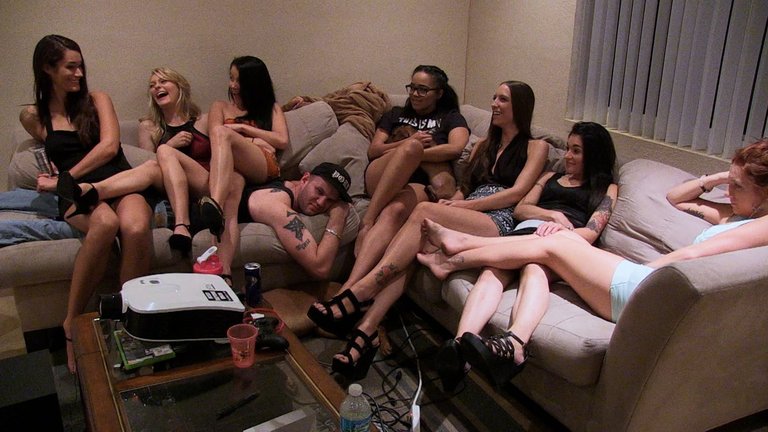
The film’s narrative engine is the experiences of six such women, aged 18 to 21, who responded to an advertisement posted by Riley, a Miami-based agent and part-time performer. In exchange for ten percent of their earnings, Riley provides them with accommodation in his home and schedules their shoots. The central arc follows Tressa, known professionally as Stella May, a 19-year-old high school graduate from Arlington, Texas, who moves to Miami to pursue this career instead of attending college as her family expected. The documentary traces a familiar trajectory: initial euphoria and excitement, fuelled by growing social media followings and a sense of newfound autonomy, followed by a rapid disillusionment. As the market’s appetite for fresh faces proves fickle, Tressa is pressured into accepting increasingly niche and extreme performances. The film documents her physical and emotional strain, culminating in health issues and the eventual intervention of her mother and initially supportive boyfriend, Kendall. Her decision to quit, erase her online presence, and return home to work as a restaurant manager is presented not merely as a personal choice but as the logical, morally correct conclusion to her story.
Hot Girls Wanted premiered at the Sundance Film Festival, garnering attention not only for its provocative subject matter but also for its association with producer Rashida Jones, whose involvement lent it a veneer of Hollywood legitimacy. Its subsequent distribution on Netflix guaranteed it a wide audience. On the surface, the film avoids the trappings of a simplistic, radical feminist critique. Bauer and Gradus largely refrain from portraying their subjects as helpless victims coerced by economic desperation or physical force. Instead, the women are presented as individuals with distinct, sometimes defiant, personalities—young adults who may be guilty of poor judgement or self-delusion but who occasionally offer sharp, perceptive commentary on their circumstances. The film even includes a fascinating segment on Belle Knox, whom the subjects view with a mixture of resentment and recognition, noting she began in similarly extreme content and has merely been more adept at leveraging her notoriety. Riley, the agent, is afforded moments of brutal honesty about the fleeting shelf-life of the performers, complicating any straightforward reading of him as a mere predator. By the documentary’s end, the attrition rate speaks volumes: of the six women followed, only two remain in the industry, with the others having quit or moved to other sectors of the sex trade.
Yet, this apparent nuance is systematically undermined by the film’s formal and editorial choices. Throughout, stark intertitles flash statistics about the prevalence of violent pornography, the youth of performers, and the alleged psychological harms of consumption. These inserts, devoid of contextual analysis or sourcing, echo the language of anti-pornography moral panics and implicitly frame the entire enterprise as a social pathology. This creates a profound dissonance: while the footage shows complex individuals making active choices, the textual commentary insists on a narrative of corruption and victimhood. Tressa’s exit is thus edited and scored to feel like a triumphant escape, a redemption arc that validates the filmmakers’ unspoken bias. The objectivity promised by the vérité style is ultimately sacrificed to a more traditional, cautionary tale structure.
This compromised stance drew mixed criticism upon release. Some praised its unflinching access, while others, particularly those within or sympathetic to the sex industry, accused it of being manipulative and inherently hostile. The criticism evidently resonated with Bauer and Gradus, who addressed it indirectly with their 2017 sequel series, Hot Girls Wanted: Turned On, which broadened the scope to explore technology’s impact on dating and intimacy. The shift suggests an awareness of the original film’s limitations.
In the end, Hot Girls Wanted is a document of a specific moment in the evolution of internet-era sex work, valuable for its raw footage and intimate access. However, its critical failure lies in its inability to fully commit to its own most interesting insights. It glimpses the nuanced reality of its subjects—their ambition, their naivety, their resilience—but repeatedly retreats into the comforting, editorialising framework of a social problem film. A decade on, as the mainstreaming of content creation has forced a more pragmatic, less hysterical public conversation, the documentary feels increasingly like a product of an older, more anxious morality. It captures the dawn of a revolution in adult entertainment but views it through the tinted lens of a past that could not quite imagine, or accept, the complex professional landscape these women were inadvertently helping to build.
RATING: 5/10 (++)
==
Blog in Croatian https://draxblog.com
Blog in English https://draxreview.wordpress.com/
InLeo blog https://inleo.io/@drax.leo
InLeo: https://inleo.io/signup?referral=drax.leo
Leodex: https://leodex.io/?ref=drax
Hiveonboard: https://hiveonboard.com?ref=drax
Rising Star game: https://www.risingstargame.com?referrer=drax
1Inch: https://1inch.exchange/#/r/0x83823d8CCB74F828148258BB4457642124b1328e
BTC donations: 1EWxiMiP6iiG9rger3NuUSd6HByaxQWafG
ETH donations: 0xB305F144323b99e6f8b1d66f5D7DE78B498C32A7
BCH donations: qpvxw0jax79lhmvlgcldkzpqanf03r9cjv8y6gtmk9