Film Review: Little Big Man (1970)

Nothing better illustrates the profound cultural and political convulsions that reshaped American society in the late 1960s than the diametrically opposed manner in which Hollywood treated the same historical event—the Battle of the Little Bighorn—and its most infamous participant, George Armstrong Custer, across a span of three decades. In 1941, Raoul Walsh’s They Died with Their Boots On, a quintessential Classic Hollywood epic, swallowed the foundational myth of the Old West hook, line, and sinker. The film transforms Custer into a martyr, sacrificing himself and his men to prevent the Indians from defeating a much larger force, a portrayal that served as potent militaristic propaganda on the eve of America’s entry into the Second World War. Three decades later, Arthur Penn’s Little Big Man (1970), steeped in the anti-establishment sentiment and wholesale questioning of the American cultural edifice that defined the era, charts a completely different course. Featuring one of Dustin Hoffman’s most iconic performances, the film stands as one of the most prominent works of the New Hollywood movement and a seminal revisionist take on the entire Western genre, systematically dismantling the heroic myths its predecessor so fervently upheld.
Interestingly, Custer is not the film’s protagonist. The basis is Thomas Berger’s 1964 picaresque novel, and the central figure is Jack Crabb (Dustin Hoffman). The plot is framed by an interview the 121-year-old Crabb—a self-described “Indian fighter” and “the only white survivor of Little Bighorn”—grants to a sceptical historian (William Hickey). This narrative device immediately establishes a subjective, unreliable, and mythic quality to the tale. The story, unspooling from Crabb’s memory, begins in 1859 when the 11-year-old Jack and his older sister Caroline (Carole Androsky) become the sole survivors of a Pawnee attack. Taken to a Cheyenne camp, Caroline escapes, but Jack remains. Raised by the tribe under the wise and kind-hearted chief Old Lodge Skins (Chief Dan George), he is given the name “Little Big Man.” This idyllic period is shattered when, as a teenager, he is captured by the US Cavalry. He is placed in the care of the hypocritical Reverend Silas Pendrake (Thayer David) and his sexually frustrated wife Louise (Faye Dunaway), beginning a picaresque odyssey through the underbelly of white civilisation. He fails as a snake-oil salesman and a gunslinger, marries a Swedish woman named Olga (Kelly Jean Peters), and, after her abduction by Cheyenne, searches for her, reconnecting with Old Lodge Skins and eventually joining the US Cavalry as a “mule skinner.” It is here he first encounters General Custer (Richard Mulligan).
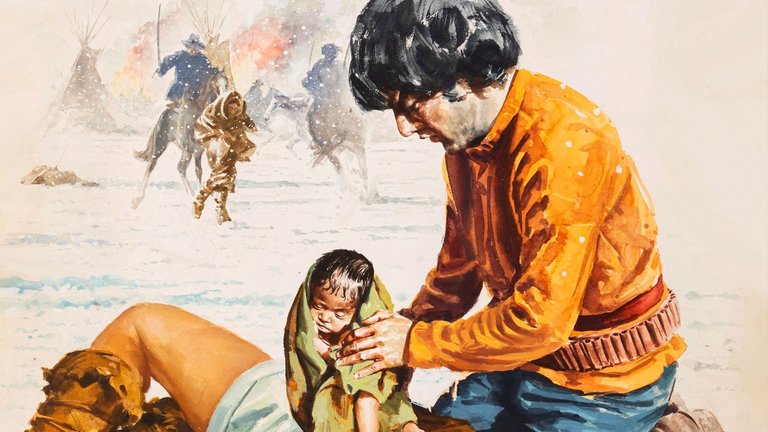
Witnessing the cavalry’s brutal massacre of Indian women and children during a raid, a disgusted Crabb deserts. He saves Sunshine (Aimée Eccles), a pregnant Cheyenne woman, rejoins his adoptive tribe, marries her and her sisters, and finds contentment. This happiness is obliterated in 1868 by Custer’s ruthless raid on the Cheyenne camp at Washita River, which claims Crabb’s family. Consumed by a desire for revenge, he infiltrates Custer’s camp but lacks the courage to kill him, descending into drunkenness and hermitry. The narrative culminates in 1876. Contemplating suicide, Crabb stumbles upon Custer’s 7th Cavalry on its final campaign. Offering his services as a scout, he is hired by a hubristic Custer, who delights in the idea of acting against Crabb’s hostile advice. In a final act of cunning, Crabb deliberately misleads Custer into advancing to the Little Bighorn, where the regiment is annihilated. In the poignant aftermath, Crabb and the ageing Old Lodge Skins discuss a future the chief knows is lost; despite their victory, the Cheyenne have lost the war. Resigned to death, Old Lodge Skins changes his mind when a life-affirming rain begins to fall—a moment of quiet, ambiguous grace.
Like many revisionist Westerns of its time, Little Big Man was forged in the crucible of the Vietnam War. By 1970, that conflict had fractured American society, turning a generation against the historical myths cherished by their forebears. The film’s script is palpably informed by contemporary events; the depiction of the US military butchering innocent women and children functions as a direct allegory for atrocities like My Lai. Director Arthur Penn would later draw explicit comparisons between the treatment of Indigenous peoples and the Holocaust, a perspective hinted at within the film itself. The historian character uses the word “genocide,” a term the 121-year-old Crabb does not recognise but whose meaning he instinctively grasps.
The massacre scenes are depicted with a visceral, explicit brutality, utilising squibs and copious fake blood to convey the horror. They are intentionally unpleasant, yet Penn’s film avoids the exploitative excess of Ralph Nelson’s similarly themed Soldier Blue (1970). Where Soldier Blue was criticised for reducing atrocity to lurid entertainment, Little Big Man integrates its violence into a broader, more nuanced tragicomic tapestry. The critique is no less severe, but it is arguably more effective for being part of a richer character study.
Yet, if the film’s intent is to confront America with its bloody past, this effort is partially undermined by its episodic, vignette-like structure—a legacy of the picaresque source material. Jack Crabb becomes a proto-Forrest Gump, tumbling through a revisionist history of the West where he samples various stereotypes: the white captive, the pious ward, the conman, the gunslinger, the cavalryman, the avenger. While this serves to deconstruct the genre’s archetypes, it can also feel disjointed, preventing a deep, sustained emotional engagement with any single episode. The narrative momentum is occasionally sacrificed for satirical breadth.
The film’s tone is a curious and sometimes unstable alloy of dark tragedy and broad humour. In the final scene, this combination works brilliantly, granting the Cheyenne and the audience a hard-won, bittersweet respite. Elsewhere, the jokes are hit-and-miss. The subplot involving Crabb’s tomboyish sister, who reappears as his gunslinging mentor, feels undercooked and tonally awkward. An episode featuring Wild Bill Hickok (Jeff Corey), while amusing, strays from history (Hickok died months after Little Bighorn) and feels like a tangential diversion. Furthermore, the satire of Bible-thumping hypocrisy via the Pendrakes is somewhat undermined by Faye Dunaway’s performance, which, while entertaining, edges into hammy caricature.
The film is notable for its embrace of the more liberal content standards of the New Hollywood, particularly in its treatment of sexuality. The character of Little Horse (Robert Little Star), an effeminate Cheyenne who shows obvious homosexual attraction to Crabb, is a remarkably progressive inclusion for a mainstream 1970 film.
What ultimately holds this sprawling, ambitious project together is Dustin Hoffman’s magnificent, chameleonic performance. He relishes the opportunity to embody Crabb’s immense complexity, transforming from a wide-eyed teenager to a broken old man. The grotesque ageing makeup, which Hoffman later said made him feel authentically old, is a testament to the commitment. Hoffman navigates each incarnation—failed criminal, reluctant husband, grieving widower, would-be avenger—with impeccable skill, providing the emotional anchor the episodic plot requires.
Equally vital is Chief Dan George as Old Lodge Skins. In a performance that made him the first Native American nominated for an Academy Award, George delivers a masterful blend of regal gravitas, weary wisdom, and gentle irony. He is the film’s moral and spiritual centre, and his relationship with Crabb provides its emotional core. His lament, “There is an endless supply of white men, but there has always been a limited number of human beings,” resonates with profound sorrow.
Penn strove for authenticity, filming near the actual battle locations in Montana and collaborating with Native American tribes who provided extras. This lends the Cheyenne camp scenes a palpable texture often absent from earlier Westerns. Casting actresses of Asian background for the roles of Sunshine and her sisters, while a pragmatic decision of the time, is a noticeable flaw in this pursuit of authenticity.
As Custer, Richard Mulligan delivers another key performance, portraying the general not as a misguided hero nor a cold professional, but as a vainglorious, murderous lunatic. His Custer is a preening megalomaniac whose demise is stripped of any martyrdom, rendered as the inevitable culmination of racist hubris. Mulligan would later cleverly reference this role in the 1984 film Teachers, playing a mentally ill man who impersonates historical figures, including Custer.
A significant artistic flaw is the film’s lack of a proper musical score. While this may have been a deliberate choice to avoid sentimentalising the story, it leaves certain sequences feeling oddly bare, lacking the sonic grandeur or emotional underscoring that a composer like, say, the aforementioned Max Steiner (who scored They Died with Their Boots On) could have provided.
Despite these imperfections—the episodic structure, the uneven humour, the absent score—Little Big Man remains a very good film. It succeeds as an entertaining, if demanding, hybrid of Western, historical epic, and black comedy. More importantly, it transcended its immediate political context. While Soldier Blue succumbed to didacticism and heavy-handedness, Little Big Man wielded its critique with greater subtlety and humanity. It served as a direct inspiration for later, more polished treatments of similar material, most notably Kevin Costner’s Dances with Wolves (1990), which would revisit the theme of a white man finding kinship with Native culture, albeit with a more romanticised and less caustic sensibility.
Little Big Man is a landmark of cinematic revisionism. It systematically dismantled the jingoistic myths, replacing heroic martyrdom with ambiguous survival, and national destiny with personal and cultural tragedy. Reflecting the disillusionment of the Vietnam era, it holds a dark mirror to American history. Flawed yet formidable, carried by powerhouse performances and unflinching in its vision, it works as a compelling, challenging inquiry into the stories a nation tells itself, and the brutal realities those stories often conceal.
RATING: 7/10 (+++)
==
Blog in Croatian https://draxblog.com
Blog in English https://draxreview.wordpress.com/
InLeo blog https://inleo.io/@drax.leo
InLeo: https://inleo.io/signup?referral=drax.leo
Leodex: https://leodex.io/?ref=drax
Hiveonboard: https://hiveonboard.com?ref=drax
Rising Star game: https://www.risingstargame.com?referrer=drax
1Inch: https://1inch.exchange/#/r/0x83823d8CCB74F828148258BB4457642124b1328e
BTC donations: 1EWxiMiP6iiG9rger3NuUSd6HByaxQWafG
ETH donations: 0xB305F144323b99e6f8b1d66f5D7DE78B498C32A7
BCH donations: qpvxw0jax79lhmvlgcldkzpqanf03r9cjv8y6gtmk9