Double Trouble: Why Our Family’s First Home Battery Was Just the Gateway Drug

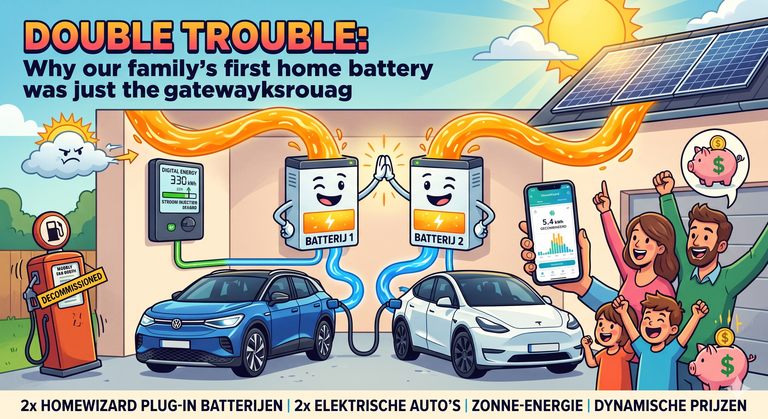
Ten years ago, when we bought our home, the solar panels were already resting proudly on the roof. Back then, we didn't fully appreciate what we had inherited. We simply looked at the roof, nodded approvingly, and thought, “Oh, how nice, free electricity for the family.” The priovus owners did install them to heat their Jacuzi. But we did sell the Jacuzi within 2 years. Wasn't used enough and too much maintenance.
We were living in the golden age of the terugdraaiende teller—the glorious, mechanical, backward-spinning analog energy meter. It was a simpler time. During the day, the sun would shine, and we would occasionally wander into the garage just to watch the little metal disc spin frantically in reverse. It was hypnotic. We felt like financial masterminds, hacking the system without lifting a finger. The grid was our infinitely large, completely free battery. We didn’t know what a kilowatt was, and frankly, we didn’t care. We were blissful, ignorant, and happy.
The Digital Awakening
Then, about five years ago, everything changed. The energy grid operator knocked on our door and replaced our beloved spinning wheel of fortune with a cold, calculating digital meter. Suddenly, the backward-spinning party was over. The grid was no longer our friend; it was a highly organized accountant. Every watt we injected into the street was tracked and paid out at a miserable rate, while every watt we bought back in the evening cost us a premium.
This digital awakening fundamentally changed us as a family. We went from being casually green to becoming aggressively obsessed with our energy monitoring app. “Kids, stop the microwave, a cloud is passing over the neighborhood!” became a completely normal sentence to shout through the hallway. With the introduction of dynamic energy contracts in 2026, we found ourselves in situations where pushing power back into the grid during peak sunshine meant negative prices. Yes, the universe was literally threatening to charge us money to take our extra sunshine away. It was deeply offensive to our family’s honor.
The Capri-Sun Dilemma
We needed a solution, which led us to our first HomeWizard plug-in battery. It felt like a massive victory. We were going to capture the sun, trap it in a sleek little box, and release it to power our television at night. We were off-grid-ish.
But then, reality hit. Our first battery was trying its absolute best, but it had a maximum charge and discharge rate of 800 watts. On a beautiful, blindingly sunny April afternoon, our inherited solar panels were screaming from the roof, aggressively pumping out 3,000 watts of pure, unadulterated power. And there was our little battery, politely sipping 800 watts through what essentially felt like a Capri-Sun straw.
The rest of that glorious, free energy? It bled right back into the grid, occasionally at those dreaded negative prices. Conversely, at 6:30 PM, when we turned on the induction stove to boil some water for pasta, the house suddenly demanded 2,000 watts. Our brave little battery pushed out its maximum 800 watts, sweating and panting, while the smart meter disappointingly bought the remaining 1,200 watts from the grid at prime-time evening prices. Clearly, one battery was just a gateway drug.
The Elephant(s) in the Driveway
To fully understand our descent into energy madness, we must address the colossal elephants parked in our driveway. We have two electric vehicles. Not one, but two. Between them, they hold enough raw lithium-ion power to jumpstart a medium-sized medieval village.
When you have two EVs, an electric ecosystem at home becomes a wildly different ballgame. An electric vehicle looks at a 2.7 kWh home battery the way a hungry teenager looks at a single grain of rice. If you let it, one of our cars will suck the home battery dry in a matter of hours, burp, and then ask for the main course from the grid.
In Flanders, where we live, the grid operator monitors your 15-minute consumption peaks like a hawkish gym teacher, billing you a "capacity tariff" based on your highest monthly spike. Between the two EVs fighting for electrons, the cooking, the washing machine, and the general chaos of family life, our monthly peak stubbornly hovers around 7 kW. We smartly cap the car charging to keep it from blowing up the neighborhood block, but managing that 7 kW peak is an extreme daily sport.
Enter Battery Number Two: The Wall-Plug Powerhouse
So, we did what any rational, app-obsessed family would do: we dropped another €1,195 and bought a second battery.
Because we only have a standard 1-phase connection, the installation process was almost comically simple. There was no need to summon an electrician with a PhD in phase balancing. We literally just found another wall outlet on a safe circuit, plugged it in, and let the software do the rest. The app instantly recognized its new sibling and merged them into one giant, virtual 5.4 kWh mega-battery.
The actual capacity is great (even though we know we only get about 4 kWh of purely usable net power out of it), but the true magic is that our "Capri-Sun straw" has been upgraded to a firehose. We now have a combined charge and discharge rate of 1,600 watts. When the sun peaks, our system aggressively gobbles up 1.6 kW of excess solar. When the morning rush hits—coffee machine blaring, toaster popping, kids running around—the twin batteries proudly shoulder the load without bothering the grid. It doesn't miraculously erase our 7 kW EV peak, but it shaves the sharp edges off our daily household consumption perfectly.
It’s Not About the Excel Sheet, It’s Ideological
People always ask us about the Return on Investment. They whip out their calculators and say, "You spent €2,390 on batteries. With the price delta between night and day, your ROI is going to be nearly ten years!"
To those people, we say: You are entirely missing the point.
Yes, we are going to charge these batteries at night when the dynamic prices hit rock bottom. Yes, we are going to let them power the house during the obscenely expensive morning peak. But this isn't just about an Excel spreadsheet anymore. It's ideological.
It is about the sheer, unadulterated joy of sticking it to the system. When the grid is overloaded and energy prices go negative, our dual-battery setup acts as a sponge, soaking up energy that the market desperately wants to discard. We then use it later to watch movies completely off the grid's radar.
We are cooking our family dinner on the very same sunbeams that hit our roof shingles six hours earlier. We are taking back control of our meter, one plug-in battery at a time. It's a team effort, a lifestyle, and a very specific type of suburban rebellion.
Now, if you'll excuse us, we need to go check the app together. We think a cloud just moved, and we need to emotionally prepare the entire household for a 200-watt drop in production.
Cheers,
Peter
So it sounds like if I ever do get solar for my residence, it's important to invest a good sum of money in to a robust battery system that has more than enough capacity to do all the things I want! Good to know!
That indeed would be a smart thing to do. Another common mistake is to have too many solarpanels.
Good to know!
Batteries are the way to go but yours are very expensive. Mine cost a similar price, but are 5.4kwh each and I am about to buy some more shortly. Reducing your reliance on the grid saving you money is what it is all about and seeing the savings is the fun part.
I know that there are cheaper ones out there. But the misses did decide and just wanted to have it made in Belgium. Nobel but costly.
A battery makes a huge difference. We don't have the negative export rates, but I can charge the battery up cheaply each morning to maximise my export. That is working well. There are so many ways to tweak things, but the family do not have to think too much about when they use power apart from mainly charging the EV on cheap rate.
!BEER
Indeed it does help a lot. Those huge negative prices are really a gift when charging the car.