The Beauty Of Nature

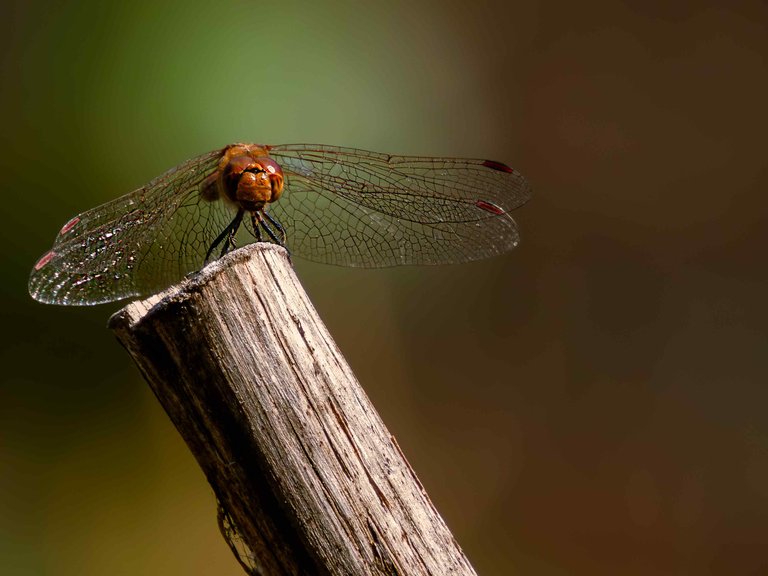
Photo Contests on Hive have been running every day for years, and although I no longer participate as actively, there are certainly times when I can't help but jump in again. Photography is no longer the most important hobby in my life. The inability to go out often has driven that away. I am convinced that the dormant photography spark will ignite again if that possibility ever returns. But until then, I also enjoy taking photos here and there of the things I see around the house. There is plenty to see there too, although it is often the case that I don't take my camera for it. But on sunny days outside, I usually have my camera with me ... and this photo was taken on such a day. A sunny September day in the backyard. Now I have to be honest, this photo is from September 16, 2023, a Sunday with the dogs outside. And suddenly there was a dragonfly, resting quietly on a wooden stick in one of our planters. When I saw that, I was happy with the enormous zoom of the P1000. That way, I didn't have to disturb the dragonfly to capture it beautifully. With most macro lenses, you have to sneak up very close and then hope that you can take a perfect photo. With the Nikon P1000, you can forget about sneaking up. You can simply zoom phenomenally far, allowing you to stay at a distance that ensures that you don't disturb the insect. I admit, with a macro lens you certainly take sharper photos. The P1000 is a bit less in that respect, but the convenience of "all-in-one" and the price difference makes me glad that I took that step.
Darter Dragonfly
The dragonfly that I photographed was a kind of darter dragonfly, but you really shouldn't ask me which subspecies it was. In any case, it was a work of art in itself. I always find the wings so beautiful to look at. That transparency in the wings, with the fine lines, could be somewhat reminiscent of stained glass windows. And the reflection of the sunlight in those wings just looks amazing. Dragonflies also have that wonderful combination of those incredibly fine and fragile-looking wings, and then such a robust and sturdy body. When I think about it for a moment, it seems synonymous with all of nature. Vulnerable and yet resilient.
Of course, many people know dragonflies by sight, and we all admire dragonflies for their appearance. But what many people do not know is that dragonflies are not only beautiful to look at. They are also very important for maintaining the balance in our ecosystem. Dragonflies are much more than just beautiful flying insects, they are the predators of the air. The diet of many dragonflies consists of small insects such as mosquitoes and flies. The fact that this contributes to controlling these populations is of course a very nice bonus for us humans. Dragonflies are one of the most important allies we humans have in the fight against those annoying stinging insects and other flying insects that can spread diseases. And also not entirely unimportant, the presence of dragonflies in the vicinity is often a sign of a healthy ecosystem. The larvae can only survive in clean water. This last point is a good sign in the Netherlands where so much water pollution has occurred in recent decades. We still have clean water here and there, so that something in our country appears to be clean enough.
The Life of the Dragonfly
Did you know that dragonflies spend most of their lives in their larval phase? They then live as nymphs in the water. And it can take many months, even years, before they become adults. And only when they become adults do they get the wings by which we recognize dragonflies. This process, known as incomplete metamorphosis, is a fine example of the power of nature. In this case, the enormous degree of transformation and adaptation that dragonflies master. After a dragonfly has lived in the water for so long, it transforms into an exceptionally agile flyer with beautiful wings. Anyone who has ever seen dragonflies fly knows that they are incredibly fast and agile. The speed they can develop is much higher than many other flying insects can, and because of their agility, dragonflies can pluck insects out of the air. They have strong jaws with which they eat the captured insects while they are still flying. So you could say that dragonflies provide us with an essential service by keeping the ecosystem in balance.
But as is so often the case. We do not live in an ideal world, and the natural balance is threatened. Just like many other insect species, the beautiful dragonflies are also under pressure from human activities. And the climate change caused by humans. Their habitat, especially the watery areas in which their larvae grow up, is disrupted by pollution, deforestation, and the destruction of wetlands.
The Threat of Climate Change
You can probably imagine the impact of climate change on insects such as dragonflies. Rising temperatures and changes in rainfall patterns, combined with longer periods of drought, have enormous consequences for their habitats. Imagine that you are a dragonfly, but the water sources dry up or become polluted. As a result, dragonfly larvae cannot survive. That these changes will inevitably lead to a decline in the populations of dragonflies and other insects will be clear to everyone. But realize that this will cause a chain reaction in the ecosystem.
Dragonflies may be predators of smaller insects themselves, but for many birds and amphibians, the dragonfly is a tasty snack. If the dragonfly population declines, we will have a surplus of mosquitoes and flies, but we will see other animals that mainly eat dragonflies disappear again. It is and remains very simple, all parts of our ecosystem are connected and where there is a disruption at one point it will always affect other parts.
For dragonflies, which are dependent on seasonal events, climate change has another disruption. Dragonflies, for example, depend on specific temperatures to complete their life cycle. Too early warm periods can disrupt their development, while irregular rainfall can affect water sources in which their larvae live. In many places around the world, we are already seeing the effects of climate change on many plant and animal species. And unfortunately, dragonflies are no exception. The effects are also already visible in dragonflies with a noticeable decline in population, with some species that were once common here, now not seen for several years.
The Importance of Preserving Nature
When I saw the theme for this week's photo contest I was reminded of how important it is to consider these threats. The world around us is changing rapidly, and at the moment it is certainly not always for the better. Nowadays I am happy when I see a dragonfly, in the 80s it was quite normal to see many dragonflies. Where for many people climate change still seems an abstract concept, and they do not want to change their behavior, for dragonflies and many other animals it is one of the greatest dangers they have to deal with. The future of many animal species is uncertain. But as long as there is life, there is hope.
View or trade
LOHtokens.@ladiesofhive, you successfully shared 0.1000 LOH with @hetty-rowan and you earned 0.1000 LOH as tips. (15/20 calls)
Use !LADY command to share LOH! More details available in this post.
View or trade
LOHtokens.@hetty-rowan, You have received 1.0000 LOH for posting in Ladies of Hive. We believe that you should be rewarded for the time and effort spent in creating articles. The goal is to encourage token holders to accumulate and hodl LOH tokens over a long period of time.