Aldous Huxley: creador y pensador del presente y el futuro (Esp | Eng)
ESP
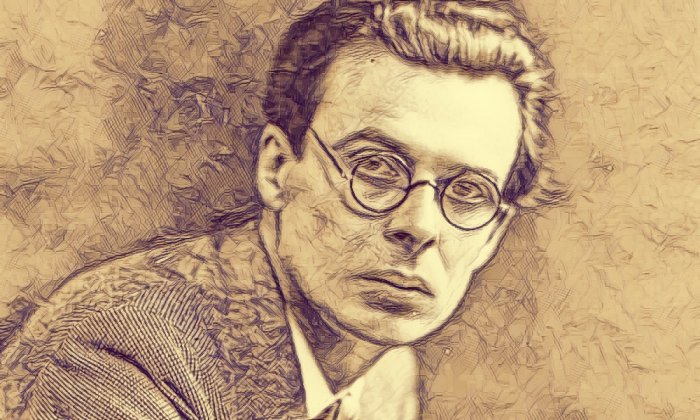
Aldous Huxley, de quien se cumplieron ayer 60 años de muerte (22 de noviembre de 1963), es un escritor británico, estimado como uno de los más importantes del siglo XX. Se caracterizó por cultivar una amplia formación intelectual, lo cual le permitió incursionar en los más diversos temas y áreas del conocimiento y la práctica humana, y trabajar en diferentes géneros textuales. Pero, sobre todo, ser gestor de un pensamiento abierto, autónomo, inquieto y sumamente crítico.
ENG
Aldous Huxley, whose death yesterday marked the 60th anniversary of his death. (November 22, 1963), is a British writer, considered one of the most important writers of the twentieth century. He was characterized by cultivating a broad intellectual formation, which allowed him to dabble in the most diverse subjects and areas of knowledge and human practice, and to work in different textual genres. But, above all, he was the manager of an open, autonomous, restless and highly critical thinking.
Como apunté, fue un intelectual muy productivo. Así, comenzó en poesía con su primer libro La rueda ardiente (1916) hasta Las cigarras y otros poemas (1931). Escribió teatro, como La sonrisa de la Gioconda (1948). También guiones de cine; entre ellos es el autor del guion original de la película animada de Disney Alicia en el país de las maravillas (1951), que fuera rechazado. Publicó cerca de ocho libros de cuentos. Desarrolló una rica escritura de ensayos y artículos periodísticos, recogidos en colecciones publicadas; entre ellos destaco, a mi gusto, Música en la noche (1931) y Las puertas de la percepción (1954). Pero donde más se le conoce es en el campo de la novela, particularmente por Un mundo feliz (1932), aunque publicó otras de relevancia como Contrapunto (1928), una obra muy reconocida por su lograda renovación técnica (en Venezuela un grupo y revista literaria de la década del 40 asumirá ese nombre), Los demonios de Loudun (1957), llevada al cine por Ken Russell en 1971. Y cabe destacar su llamativa última novela, La isla (1962).
Huxley fue un gran viajero y vivió en varios países por algún tiempo, como en Italia, Francia y España, pero se residenció definitivamente en Estados Unidos hasta su muerte. Sus búsquedas personales lo llevaron a un acercamiento profundo con el misticismo oriental y precolombino, en lo que juegan un papel capital sus viajes a India, Japón, China y México. Y también a experimentar, en su indagación espiritual y mental, con sustancias alucinógenas como la mescalina y el LSD. Se dice que en su agonía de muerte, producto de un cáncer, "le fue leído al oído, según su propio deseo, el Libro tibetano de los muertos. También pidió se le administrasen dos dosis casi sucesivas de LSD como terapia agónica, tras lo cual murió plácidamente".
As I noted, he was a very productive intellectual. Thus, he started in poetry with his first book The Burning Wheel (1916) until The Cicadas and Other Poems (1931). He wrote plays, such as The Gioconda Smile (1948). He also wrote film scripts; among them he is the author of the original screenplay for the Disney animated film Alicia in Wonderland (1951), which was rejected. He published about eight books of short stories. Furthermore, he developed a rich writing of essays and journalistic articles, collected in published collections; among them I highlight, to my taste, Music at Night and other Essays (1931) and The Doors of Perception (1954). But where he is best known is in the field of novels, particularly for Brave New World (1932), although he published others of relevance as Point Counter Point (1928), a work well known for its successful technical renovation (in Venezuela a group and literary magazine of the 40's will assume that name), The Devils of Loudun (1957), made into a film by Ken Russell in 1971. And it is worth mentioning his striking last novel, The Island (1962).
Huxley was a great traveler and lived in several countries for some time, such as Italy, France and Spain, but he resided definitively in the United States until his death. His personal searches led him to a deep approach to oriental and pre-Columbian mysticism, in which his trips to India, Japan, China and Mexico play a capital role. And also to experiment, in his spiritual and mental research, with hallucinogenic substances such as mescaline and LSD. It is said that in his death agony, product of a cancer, "the Tibetan Book of the Dead" was read in his ear, according to his own wish. He also asked to be administered two almost successive doses of LSD as agonic therapy, after which he died peacefully".

Reproduzco a continuación fragmentos de dos de sus novelas y de dos de sus libros ensayísticos.
De Un mundo feliz
Se sentó al borde del precipicio. La luna estaba tras él; miró hacia abajo, hacia las negras sombras, en las negras sombras de la muerte. Sólo había que dar un paso, un saltito… Alzó su mano derecha a la luz de l luna. Del corte de su muñeca corría sangre aún. Cada varios segundos, caía una gota, otr gota, otra gota… Mañana y mañana, y mañana…
Había descubierto el Tiempo, la Muerte y Dios.
Un mundo feliz (1932) es, junto a 1984 de Orwell (publicada en 1948), las dos primeras grandes novelas distópicas. En el enlace siguiente, pueden encontrar un resumen de ella, en caso de no haberla leído y no poder hacerlo de inmediato.
De La isla
Es la pena inherente a la condición humana, el precio que debemos pagar por ser organismos sensibles y conscientes de sí mismos, aspirantes a la liberación, pero sometidos a las leyes de la naturaleza, y sometidos a la orden de continuar marchando a través del tiempo irreversible, a través de un mundo absolutamente indiferente a nuestro bienestar, hacia la decrepitud y la certidumbre de la muerte.
Separada de Un mundo feliz por 30 años, La isla, una extraña novela, pareciera mostrarse como una antípoda de aquella, pues aquí la vida transcurre de un modo radicalmente diferente; sin embargo, diría, siempre bajo la idealización propia de toda utopía, que hemos visto, parafraseando a Goya, produce monstruos.
I reproduce below excerpts from two of his novels and two of his essay books.
From Brave New World
He sat on the edge of the cliff. The moon was behind him; he looked down into the black shadows, into the black shadows of death. He only had to take one step, one little jump... He raised his right hand to the moonlight. Blood was still flowing from the cut on his wrist. Every few seconds, a drop fell, another drop, another drop... Tomorrow and tomorrow, and tomorrow...
He had discovered Time, Death and God.
Brave New World (1932) is, together with Orwell's 1984 (published in 1948), the first two great dystopian novels. In the following link, you can find a summary of it, in case you have not read it and cannot do so immediately.
From The Island
It is the penalty inherent in the human condition, the price we must pay for being sentient and self-aware organisms, aspiring to liberation, but subject to the laws of nature, and subjected to the order to continue marching through irreversible time, through a world absolutely indifferent to our well-being, towards decrepitude and the certainty of death.
Separated from A Brave New World by 30 years, The Island, a strange novel, seems to appear as an antipode of the former, since here life takes place in a radically different way; however, I would say, always under the idealization of all utopia, which we have seen, paraphrasing Goya, produces monsters.

De Música en la noche
La substancia de una obra de arte es inseparable de su forma; su verdad y su belleza son dos cosas distintas, y, al propio tiempo, no se sabe por qué, una sola.
De Las puertas de la percepción
Vivimos juntos y actuamos y reaccionamos los unos sobre los otros, pero siempre, en todas las circunstancias, estamos solos.
Condenso mis comentarios de ambas citas, en uno solo. Así como la obra de arte verdadera es una conjunción trascendente de la separación entre forma y contenido, en una paradoja quizás incomprensible, los seres humanos, en particular los que cultivan un arte auténtico, son la consumació0n de la individualidad, que puede llamarse soledad.
From Music in the Night
The substance of a work of art is inseparable from its form; its truth and its beauty are two distinct things, and, at the same time, it is not known why, one and the same.
From The Doors of Perception.
We live together and act and react upon one another, but always, in all circumstances, we are alone.
I condense my comments from both quotes, into one. Just as the true work of art is a transcendent conjunction of the separation between form and content, in a perhaps incomprehensible paradox, human beings, particularly those who cultivate authentic art, are the consummation of individuality, which can be called solitude.
Referencias | References:
Huxley, Aldous (1983). Un mundo feliz. México: Editores Mexicanos Unidos.
Huxley, Aldous (1977). La Isla. Argentina: Editorial Suramericana.
Huxley, Aldous (1980). Música en la noche. España: Biblioteca Universal Carlat.
Huxley, Aldous (2007). Las puertas de la percepción. Argentina: Edit. Suramericana.
Si están interesados, pueden acceder a ciertas obras en español o en inglés de Aldous Huxley entrando en los siguientes enlaces | If you are interested, you can access some of Aldous Huxley's works in English or Spanish by clicking on the following links::
https://www.lecturalia.com/autor/4981/aldous-huxley
https://www.isfdb.org/cgi-bin/ea.cgi?1672

Gracias por su lectura | Thank you for reading.




Esta publicación ha recibido el voto de Literatos, la comunidad de literatura en español en Hive y ha sido compartido en el blog de nuestra cuenta.
¿Quieres contribuir a engrandecer este proyecto? ¡Haz clic aquí y entérate cómo!
https://inleo.io/threads/josemalavem/re-leothreads-2p8mphixp
The rewards earned on this comment will go directly to the people ( josemalavem ) sharing the post on LeoThreads,LikeTu,dBuzz.
Has sido curado por @visualblock / You've been curated by @visualblock
Bienvenidas delegaciones / Delegations welcome
Trail de Curación / Curation Trail
Vota por nuestro Testigo aliado - @hispapro / Vote for our allied Witness - @hispapro
Más información sobre el testigo aquí / More information about the witness here
Gracias, amigos de @visualblock y de @hispapro.
Encantados de apoyar trabajos de calidad como el tuyo. 🤗
🙏