La decoración navideña nos la tomamos muy en serio y el nacimiento y el árbol se ponen el 1 de diciembre. Cada año se cambia la decoración y los colores del árbol, y queda tan hermoso que es costumbre que los niños y los vecinos se tomen fotos con él. Toda la mantelería, los cojines, las cortinas, las flores, los cubiertos, los platos que se utilizan, son navideños. Este tipo de objetos están guardados todo el año y solo se utilizan en estas fechas. Tenemos objetos navideños tan viejos como nosotras mismas, pero que están en mejores en condiciones que nosotras porque están bien resguardados y solo se usan 30 días al año.
Pasados estos días, en enero, ya nadie quiere comer hallacas y nadie se anota para recoger la decoración. Es como si enero nos cambiara y saltáramos a otro carril, uno de una resaca, de una nostalgia, de un desgano. Entonces el árbol dura como hasta el 21 de enero, cuando decidimos quitarlo y recoger los otros adornos, meterlos en sus cajas, hasta que comience nuevamente diciembre y vuelvan a ver luz. La luz que también nosotros sentimos y que sin saber por qué, nos llega solo en diciembre.

Este post es mi participación a la iniciativa 39 de Esa vida nuestra creada por la amiga @charjaim. Si quieres participar, aquí está el enlace de la publicación. Me gustaría invitar a @isauris y a @josemalavem para que hablen de sus costumbres y excentricidades en navidad.
Imágenes de mi galería personal y texto traducido con google

Gracias por vuestra lectura y comentario, amigo. Saludos
Versión en inglés
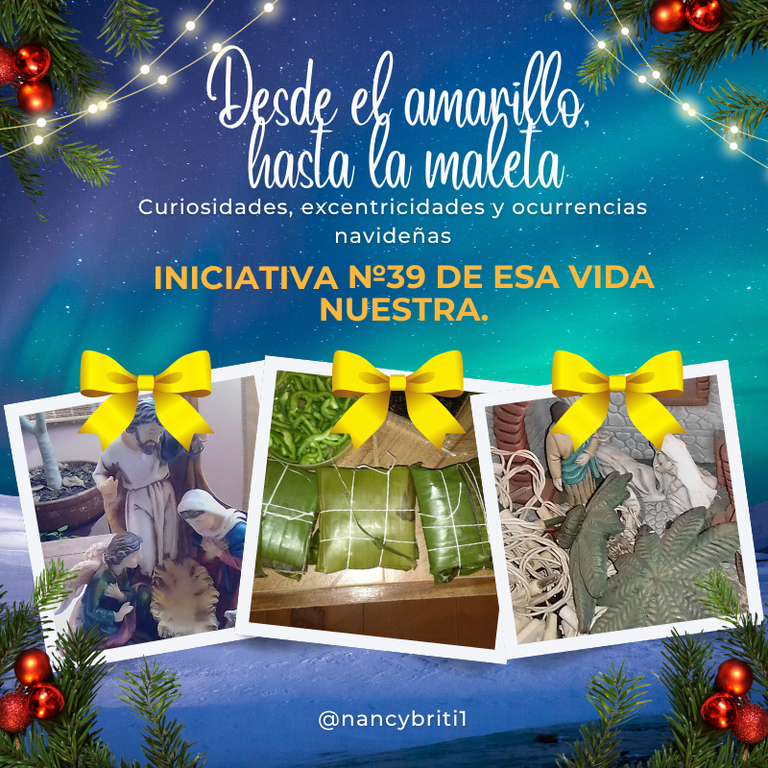
Image created in Canva
From the yellow, to the suitcase
At my house, we celebrate Christmas and the arrival of the New Year. Both dates are important for the family, where we get together at home, eat, drink, and stay up all night, even during the most difficult times. There are traditions passed down from my grandmother, like making ponchecrema and chicken sancocho on the 25th and 1st, to get through the hangover and the sleepless night; others are trends that we have adopted and usually follow at our convenience, for example, wearing yellow underwear or carrying a suitcase.

Regarding food, hallacas, pan de jamón, and chicken salad are always made. The breads are made on the 22nd and the hallacas on the 23rd. So many are made that we spend the rest of the month eating hallacas and pan de jamón: breakfast, lunch, and dinner. Since there are a lot of people at home, it's considered a bad habit (as my mom says), the hallacas have ribbons: those with one ribbon don't have olives or raisins, those with two ribbons are spicy, those with three ribbons are chicken, and those with four ribbons are black bean hallacas (yes, at home they make hallacas with black beans). Often, the ribbons come off and it becomes a mess. The pan de jamón also isn't just one type: some are ham and cheese, without olives or raisins; and there are others that have smoked pork and even melted yellow cheese.

If we talk about tradition, we always wear new clothes and shoes on the 24th and 31st, and we also wear yellow underwear. Rather than playing Secret Santa, we do a gift exchange on the 24th. Generally, we don't leave the house, because friends, cousins, and neighbors come over. Speaking of the house, we paint and thoroughly clean it (we get rid of what’s useless, broken, or unused). This cleaning is done as a family, and as my mom says: we throw a party that day. On the 31st, the whole family hugs each other, waiting for the arrival of the new year with high-denomination bills in their hands. Then we go out to wish our neighbors a Happy New Year and set a table full of food on the porch to share with whoever comes.

We take Christmas decorations very seriously, and the nativity scene and the tree are put up on December 1st. Every year, the decorations and the colors of the tree are changed, and it looks so beautiful that it's customary for children and neighbors to take photos with it. All the tablecloths, cushions, curtains, flowers, cutlery, and plates used are Christmas-themed. These kinds of items are stored all year and only used during this season. We have Christmas items as old as we are, but they are in better condition than us because they are well preserved and only used 30 days a year.
After these days, in January, no one wants to eat hallacas anymore and no one volunteers to take down the decorations. It's as if January changes us and we jump to another lane, one of a hangover, of nostalgia, of listlessness. Then the tree lasts until around January 21, when we decide to take it down and gather the other ornaments, put them in their boxes, until December comes again and they see the light once more. The light that we also feel and that, without knowing why, only reaches us in December.
Images from my personal gallery and text translated with Google
Thank you for your reading and comment, my friend. Cheers

Me veo tan reflejado en este escrito.
Creo que tenmos patrones que ahora, que hemos salido a muchas partes, los valoramos realmente.
Muy buen post, @nancybriti1
Es revivir navidades en casa.
Como venezolanos somos una gran familia que tiene raíces y lazos que nos unen. Tradiciones que nos igualan y nos hacen hermanos. Un abrazo, amigo
Thanks to @ecency and to you for your support, my friend @seckorama.
¡Felicidades! Esta publicación obtuvo upvote y fue compartido por @la-colmena, un proyecto de Curación Manual para la comunidad hispana de Hive que cuenta con el respaldo de @curie.
Si te gusta el trabajo que hacemos, te invitamos a darle tu voto a este comentario y a votar como testigo por Curie.
Si quieres saber más sobre nuestro proyecto, te invitamos a acompañarnos en nuestro servidor de Discord.
Muchas gracias por el apoyo, amigos! Feliz y agradecida
Así es tal cual lo pintas. Me recuerdo cada navidad preguntándome por qué no organicé las luces del arbolito y las guardé con cuidado para no pasar trabajo con eso al final de año. Hay una alegría decembrina que se transforma en desgano cada enero que dura sesenta días.
¿Ya cumpliste años?
Bello post,así como narras es literalmente la vida del venezolano.
Me identifique.
Gracias por compartir.
Bendiciones.