An Analysis of Bitcoin's Energy Consumption Relative to Global Industries

Concerns regarding the environmental impact of Bitcoin mining frequently center on the amount of electricity the network consumes and the resulting carbon emissions. To accurately assess the significance of these figures, it is necessary to compare Bitcoin’s energy consumption and carbon footprint with other major global industries. By reviewing data from organizations like the Cambridge Bitcoin Energy Consumption Index (CBECI) and various industry reports, a contextual understanding of Bitcoin's energy usage emerges.

Current Energy Usage and Carbon Emissions
According to estimates from the CBECI, the Bitcoin network consumes approximately 79 Terawatt-hours (TWh) of electricity annually. Based on this energy usage, the industry is estimated to produce 22.1 Megatonnes of carbon dioxide () per year. While these numbers are substantial in isolation, they represent a small fraction of the total energy utilized by established global sectors.
Comparative Analysis with Global Sectors
Building and Construction Industry
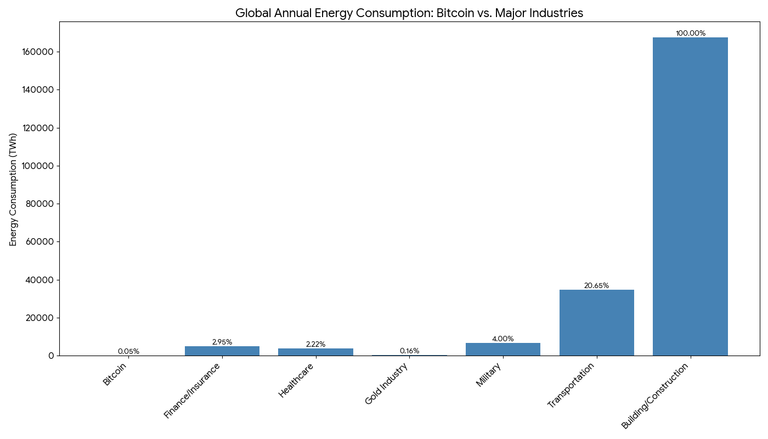
The building and construction sector is a massive consumer of energy, utilizing roughly 167,472 TWh annually—over 2,000 times more than Bitcoin. In terms of carbon emissions, this sector produces approximately 36,440 Megatonnes of annually, compared to Bitcoin’s 22.1 Megatonnes. Consequently, Bitcoin’s energy consumption is approximately 0.19% of this sector, and its emissions are about 0.18%.
Transportation Industry
The global transportation industry, encompassing road vehicles, shipping, and aviation, consumes 34,582 TWh of energy per year. Bitcoin’s consumption represents 0.23% of this total. Regarding emissions, transportation produces 8,096 Megatonnes of , while Bitcoin produces 22.1 Megatonnes, or 0.28% of that amount.
Healthcare Industry
Data from the European Journal of Public Health indicates that the healthcare sector consumes 3,716 TWh of electricity and produces 1,603 Megatonnes of annually. Bitcoin’s energy use is approximately 2.1% of the healthcare sector's consumption, and its carbon emissions represent about 1.4% of the sector's total output.
Gold Mining and Jewelry
The gold industry, including both mining and manufacturing, requires 265 TWh of electricity annually and produces 145 Megatonnes of . Bitcoin’s energy consumption is approximately 29.8% of the gold industry’s usage, and its carbon footprint is about 15.2% of that industry’s emissions.
Finance and Insurance
Studies utilizing models from the University of California, Berkeley, estimate that the traditional finance and insurance industry consumes 4,939 TWh of electricity annually. Bitcoin’s energy usage is about 1.6% of this sector, and its production is also roughly 1.6% of the amount produced by traditional financial institutions.
Military-Industrial Complex
The global military-industrial complex consumes an estimated 6,691 TWh annually, producing 2,500 Megatonnes of . Bitcoin’s electricity consumption is approximately 1% of this total, and its carbon emissions are about 0.88% of the complex's output.
Direct Comparisons
Here are the graphs illustrating how Bitcoin's energy consumption compares to other major global industries based on the data provided:
1. Global Annual Energy Consumption Comparison
This bar chart shows the absolute energy consumption in Terawatt-hours (TWh) for each industry. The percentage displayed above each bar represents how small Bitcoin's energy usage is compared to the Building and Construction industry.
2. Percentage Share of Total Energy
This pie chart highlights the percentage share of total energy consumed by these listed industries. Bitcoin (in orange) makes up a tiny fraction of the total consumption shown.

Does this visual data help put Bitcoin's energy consumption into perspective for you?
Conclusion
When analyzing global data, Bitcoin consumes significantly less energy than other major commodities and industrial sectors. While the energy consumption of Bitcoin is not negligible, contextualizing it against industries such as construction, transportation, and traditional finance shows that it constitutes a small percentage of global industrial energy usage. These comparisons suggest that Bitcoin's energy footprint is relatively small when evaluated alongside established global economic activities.
References for fruther reading and verification
To ensure accuracy, the figures in the essay are based on estimates from several research organizations. Because Bitcoin mining data changes frequently based on network difficulty and energy prices, these figures represent annual estimations using 2023-2024 data.
Bitcoin Energy and Emissions Data
- Energy Consumption: 79 TWh per year.
- Source: Cambridge Centre for Alternative Finance (CCAF), Cambridge Bitcoin Electricity Consumption Index (CBECI).
- Carbon Emissions: 22.1 Megatonnes per year.
- Source: Cambridge Centre for Alternative Finance (CCAF), Blockchain Network Sustainability Index (CBNS) - Greenhouse Gas Emissions.
Comparative Industry Data
| Industry | Energy Usage (TWh) | Emissions () | Reference Sources |
|---|---|---|---|
| Building & Construction | ~167,472 | ~36,440 | International Energy Agency (IEA); United Nations Global Alliance for Buildings and Construction. |
| Transportation | ~34,582 | ~8,096 | IEA Global EV Data Explorer; Our World in Data (Energy Consumption). |
| Healthcare | ~3,716 | ~1,603 | European Journal of Public Health ("Health Care’s Climate Footprint"); Health Care Without Harm. |
| Gold Mining/Jewelry | ~265 | ~145 | DePaul University study on gold environmental impact; Industry reports cited by Bitcoin Magazine. |
| Finance & Insurance | ~4,939 | ~1,368 | University of California, Berkeley (CoolClimate Network Model); Academic analysis of financial data center consumption. |
| Military Complex | ~6,691 | ~2,500 | Scientists for Global Responsibility (SGR); Conflict and Environment Observatory (CEOBS) 2022 report. |
Does this visual data help put Bitcoin's energy consumption into perspective for you?
Posted Using INLEO
⚠️⚠️⚠️ ALERT ⚠️⚠️⚠️
HIVE coin is currently at a critically low liquidity. It is strongly suggested to withdraw your funds while you still can.
Since Bitcoin is often called Digital Gold, seeing that it uses less than 30% of the energy and produces only 15% of the emissions of the actual gold industry is a huge win for the digital argument.
I agree, good focus point or talking point
https://x.com/i/status/2022943264954094054
#hive #posh
Thank you for sharing my post.
Bitcoin is really changing and helping to transform a whole lot of lives and this is actually the beginning
Yes, I agree, for those that learn to earn or save in Bitcoin, bitcoin will change their lives.