Lo que fallan los novatos al realizar la Plancha ❌⚙️🔥 [ESP-ENG]
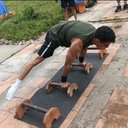


Errores comunes al empezar y cómo corregir este estático desde cero 📈✅🤸♂️
Common mistakes when starting out and how to correct this static from scratch 📈✅🤸♂️
Voy a hablarles sobre algo que suele ocurrir al momento de practicar la plancha en el mundo de la calistenia, algo que también me pasó a mí cuando comencé en esta disciplina. Me refiero a la importancia de usar una buena técnica, realizar un bloqueo correcto de los codos y aplicar la protracción escapular en este estático. En esta publicación les compartiré imágenes de mi rutina, las cuales usaré para explicar y profundizar en estos aspectos. Todo esto y más lo verán a continuación. Sin más nada que decir, comencemos.
I'm going to talk about something that often happens when practicing planche in the world of calisthenics, something that also happened to me when I started in this discipline. I'm referring to the importance of using good technique, properly locking your elbows, and applying scapular protraction in this static hold. In this post, I'll share images of my routine, which I'll use to explain and delve deeper into these aspects. You'll see all this and more below. Without further ado, let's begin.
Algo clave en este estático es el concepto de "palanquear" o empujar con los hombros. Me refiero a la transición correcta desde una posición de L-sit hacia la tuck planche. En este movimiento, se deben priorizar varios factores, como el control y la ejecución precisa. Aunque parece simple, para un principiante puede ser muy desafiante, ya que sienta las bases para movimientos más complejos, como el press de plancha a handstand. Se puede aumentar la dificultad realizando un L-sit a tuck planche con un minipress, lo cual es sumamente beneficioso.
Otro aspecto importante es la mirada. Al realizar el estático, la vista debe dirigirse a unos 45 grados, ni demasiado arriba ni demasiado abajo, para mantener la alineación corporal.
Un ejercicio que antes ejecutaba de manera incorrecta es la plancha en agarre supino. En esta posición, partimos de un fondo supino y empujamos con los brazos hacia abajo, como si quisiéramos hundir la barra en el suelo, hasta alcanzar la posición de plancha en agarre supino. Puede variarse en progresiones como la tuck planche supina o la plancha supina en remo. El objetivo es activar los músculos adecuados, especialmente la escápula. En mi caso, antes no empujaba correctamente la barra ni activaba la escápula, sino que elevaba demasiado la cadera, lo que generó un mal hábito. Aún debo mejorar mucho en esta variante, y es algo que trabajo constantemente, ya que para ser un buen atleta es esencial dominar distintas versiones de los ejercicios.
La plancha requiere un constante "palanqueo" durante su ejecución, aunque lo frenamos para mantenernos estáticos y paralelos al suelo. Por eso, los componentes esenciales de este estático incluyen aguantes, presses (tanto en la fase positiva como en la negativa) y, sobre todo, una base sólida en los fundamentos. Si quieres lograr un press a handstand, es indispensable dominar previamente la parada de manos. Sin esto, el avance se vuelve mucho más difícil.
Aún tengo aspectos por mejorar, pero quería compartir estas reflexiones con ustedes, ya que considero que son curiosas e interesantes. Esperen mis próximas publicaciones, no se las pierdan.
A key aspect of this static position is the concept of "leveraging" or pushing with the shoulders. I'm referring to the correct transition from an L-sit to the tuck planche. In this movement, several factors must be prioritized, such as control and precise execution. Although it seems simple, it can be very challenging for a beginner, as it lays the foundation for more complex movements, such as the planch press to handstand. You can increase the difficulty by performing an L-sit to tuck planche with a mini-press, which is extremely beneficial.
Another important aspect is gaze. When performing the static position, your gaze should be directed at about 45 degrees, neither too high nor too low, to maintain body alignment.
An exercise I used to perform incorrectly is the supinated grip planche. In this position, we start from a supine push-up and push down with our arms, as if trying to bury the bar in the floor, until we reach a planche position with a supine grip. This can be varied with progressions like the supine tuck planche or the supine planche row. The goal is to activate the appropriate muscles, especially the scapula. In my case, I wasn't pushing the bar correctly or activating my scapula before; instead, I was raising my hips too high, which created a bad habit. I still have a lot to improve in this variation, and it's something I'm constantly working on, since mastering different versions of exercises is essential to being a good athlete.
The planche requires constant leverage during its execution, although we control it to maintain a static position parallel to the floor. Therefore, the essential components of this static position include holds, presses (both in the positive and negative phases), and, above all, a solid foundation in the fundamentals. If you want to achieve a handstand press, mastering the handstand beforehand is essential. Without this, progress becomes much more difficult.
I still have areas for improvement, but I wanted to share these thoughts with you, as I find them interesting and intriguing. Stay tuned for my next posts; don't miss them!
Creating unique professional content for you
Traductor: DeepL
Camera used: Xiaomi Redmi14C
Translator: DeepL
 |
|---|

For the best experience view this post on Liketu